NGN Partial-Credit Workshop · Learner handout
Read the rule before calculating
These fictional non-clinical items isolate the arithmetic. Actual items require clinical reasoning and instructions. A practice-item raw score is not an NCLEX pass probability. The exam uses an adaptive measurement process; do not turn this workshop into a pass-prediction calculator.
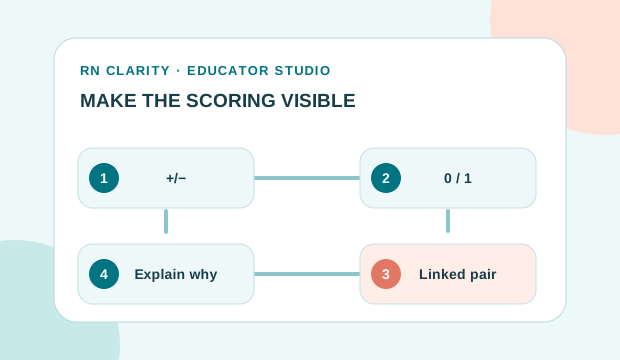
Exercise A · Plus/minus
Instruction: select all even numbers in 2, 3, 4, 7 and 8. The key is 2, 4 and 8. There is no prescribed selection count. Each selected key option earns one point; each selected incorrect option subtracts one. The item score cannot be negative and cannot exceed three.
| Selections | Correct selected | Incorrect selected | Score out of 3 |
|---|---|---|---|
| 2, 4, 8 | ______ | ______ | ______ |
| 2, 3, 4 | ______ | ______ | ______ |
| 2, 3, 7 | ______ | ______ | ______ |
| 2, 3, 4, 7, 8 | ______ | ______ | ______ |
| No options | ______ | ______ | ______ |
Exercise B · Zero/one
Instruction: select exactly two primary colours from red, green, blue and orange, using the traditional red-yellow-blue paint-colour set specified for this exercise. The key is red and blue. Each correctly selected key option earns one point; an incorrect choice earns zero. The maximum is two.
| Selections | Points for each selection | Score out of 2 |
|---|---|---|
| Red and blue | ______ | ______ |
| Red and green | ______ | ______ |
| Green and orange | ______ | ______ |
Exercise C · Linked-pair rationale
Match the shape to its defining statement: triangle → has three sides; square → has four equal sides and four right angles. Each row is one linked pair. A row earns one point only if both its shape and statement are correct. The maximum is two. This illustrates a two-element paired rule; it does not describe every rationale-format variant.
| Row response | Are both parts correct? | Pair point |
|---|---|---|
| Triangle + has three sides | ______ | ______ |
| Square + has three sides | ______ | ______ |
| Square + has four equal sides and four right angles | ______ | ______ |
Transfer the lesson to clinical options
- Explain why selecting an unsupported extra option can reduce a plus/minus score.
- Explain why leaving every option blank does not earn points.
- What should you check when the instruction gives a fixed number of selections?
- For a linked clinical pair, explain the relationship, not merely two isolated facts.
- Use cues, the instruction and clinical knowledge. Do not wait for impossible 100% certainty or choose every option as a scoring shortcut.
Exit ticket
Complete: “The rule for this item is ____. My selected option is supported by ____. The additional option I rejected is unsupported because ____.”