Does the Pearson VUE Trick (PVT) Still Work in 2026?
Understand unofficial Pearson VUE Trick claims, good and bad pop-up labels, payment holds, duplicate-registration risks and the legitimate NCLEX results pathway in 2026.
1. Quick Answer and Essential Facts
The Pearson VUE Trick is not an official or validated way to find out whether you passed the NCLEX-RN in 2026. A registration message, card decline, pending payment or refund cannot replace your examination result. RN Clarity does not recommend buying another examination registration to test a prediction. The safest step-by-step approach is to use your existing account, wait for the legitimate results pathway and resolve any account or payment problem separately.
People use the abbreviation PVT for an attempt to infer their result by starting another NCLEX registration after testing. They call some blocking messages a “good pop-up” and some payment or registration outcomes a “bad pop-up.” Those are community labels. They are not the names of result categories published by NCSBN or Pearson VUE. A checkout screen answers a registration or payment question; it is not your score report.
| Your question | The useful answer |
|---|---|
| Does PVT still work in 2026? | There is no official published validation establishing it as a reliable results service. |
| Is a blocked registration a pass? | It does not establish a pass. |
| Is an accepted payment a fail? | It does not establish a fail. |
| Is there a guaranteed PVT hold refund? | No universal PVT refund or hold-release timetable is established by the official guidance cited here. |
| When are Quick Results available? | The official service describes two business days, for eligible candidates whose US nursing regulatory body participates. |
| Can I practise after Quick Results say pass? | Unofficial results do not authorize nursing practice; verify your licence with the regulator. |
Official source: NCLEX Quick Results. This guide explains how to interpret information safely, not how to bypass registration or payment controls. It is aligned with the NCLEX-RN Test Plan effective April 2026; a payment experiment is not part of that test plan.
2. Start Here: A Safe Results-Checking Plan
Begin by deciding what you actually need to know. Most candidates need their pass or fail result. Some also need confirmation that a licence has been issued, while others need help with a duplicate payment, an inaccessible account or a delayed application. These are separate questions. Keeping them separate prevents a frustrating cycle in which each new screen seems to change the meaning of the previous one.
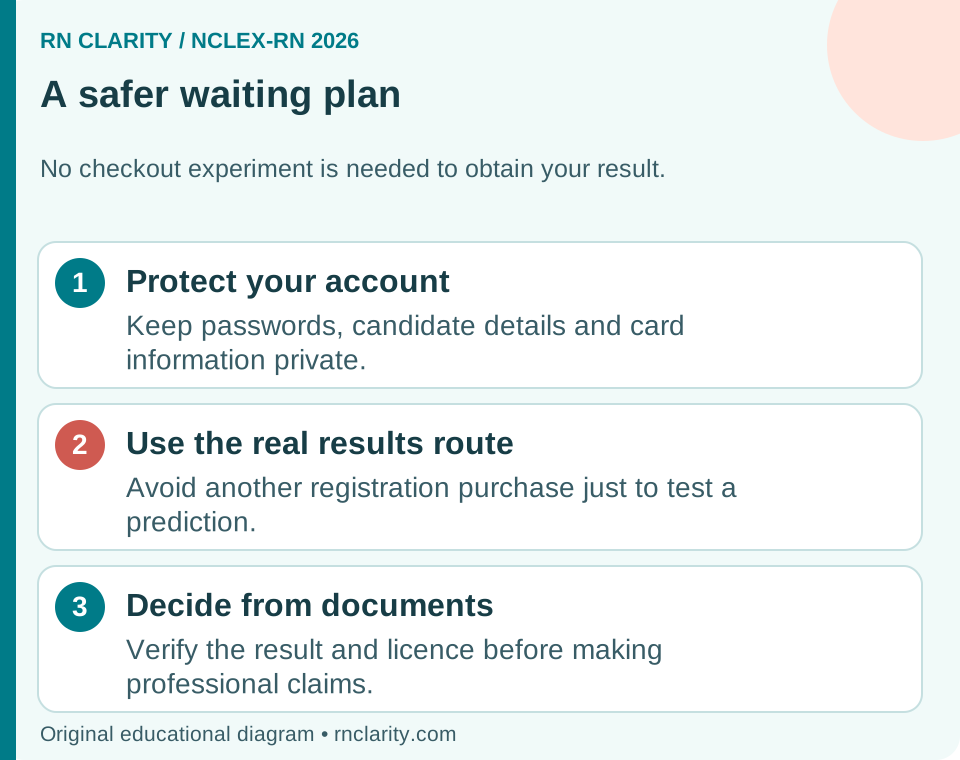
First, confirm that you can sign in to the account used for your examination. Keep your candidate information private. Do not send your password, identification document, full card number or examination appointment details to someone who offers to run the trick for you. Second, read the results instructions for the nursing regulatory body to which you applied. Third, use Quick Results only if it is offered for your registration and you want to purchase that unofficial service. Fourth, confirm licensure through the regulator before making a claim that you are authorized to practise.
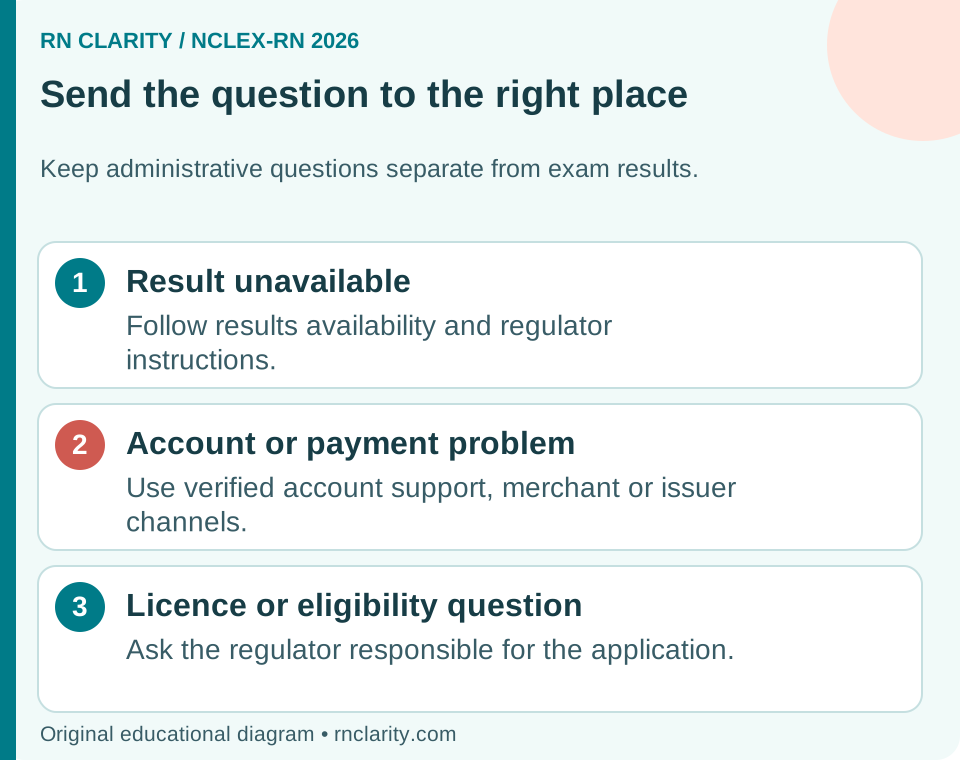
This sequence gives you one reliable destination for each decision. An account problem goes to account support. A payment question goes to the merchant or your card issuer, depending on what needs clarification. A licensure question goes to the nursing regulator. Emotional reassurance can come from a trusted person, but that person should not need to make a financial transaction on your behalf.
Write those destinations down before opening social media. A clear plan reduces the temptation to switch between banking apps, registration pages and comment threads looking for a hidden clue. Waiting is uncomfortable, but collecting more ambiguous signals does not necessarily provide more information.
Go deeper: Understand registration, eligibility and authorization in the NCLEX registration guide.
3. What the Pearson VUE Trick Actually Tries to Measure
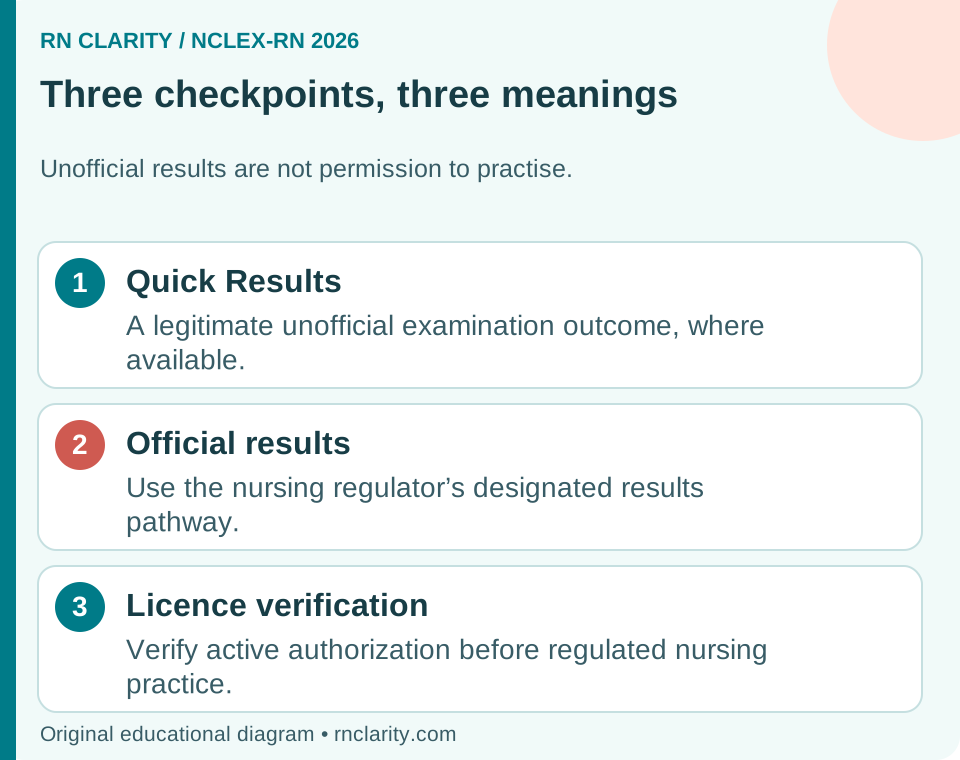
The unofficial idea behind PVT is that the ability to register again might reflect the outcome of the examination just completed. That is a proposed relationship between two different systems: an examination-results process and a registration transaction. Even if those systems exchange information, that does not mean every visible registration response has a single result-related cause.
Imagine a building with a locked door. Finding the door locked tells you that you cannot enter through that door at that moment. It does not tell you why. The room may already be reserved, your access may be incomplete, the system may be undergoing maintenance or an administrative rule may apply. To identify the cause, you need information from the system responsible for that decision. The same reasoning applies to a registration block.
The distinction is practical. A valid score report explicitly reports an examination outcome. A registration message generally describes what can or cannot happen during registration. A financial notification describes a payment event. Those documents have different purposes and should support different decisions.
If someone says a particular outcome “worked for everyone in my group,” ask what they mean by worked. Did the message precede an official result? Were contradictory outcomes counted? Were timing, account status and payment conditions comparable? Was the denominator every person who tried it or only the people who chose to post? Without those answers, a collection of experiences cannot establish reliability for your own attempt.
This is an evidence question, not a criticism of candidates sharing their experiences. A person can describe their own sequence honestly while unintentionally implying more certainty than the sequence supports. Your safest interpretation is to accept their experience as theirs and wait for the document intended to report yours.
4. What “Good Pop-Up” Means—and Does Not Mean
In candidate discussions, a “good pop-up” usually refers to a message that blocks another registration or indicates that an existing registration prevents a new one. The exact wording and point at which the message appears may vary. This guide does not present an invented screenshot or claim that one sentence is the universal Pearson VUE message in 2026.
An illustrative description would be: the website indicates that another registration cannot currently be completed. That is a description of a registration outcome, not a quotation of a verified result message. People may interpret it optimistically because they have seen similar screens before passing. The interpretation remains unofficial.
What can you conclude? You can conclude that the transaction did not proceed in the way you expected. What cannot you conclude? You cannot conclude that your board has issued a licence, that your examination result is final or that no administrative issue remains. You also cannot use the message to claim a personal pass probability.
If this happens to you, stop rather than repeatedly changing information to force another response. Record the message privately if it relates to a legitimate account problem. Then return to the official results pathway. You do not need to defeat the block to learn your result.
A reassuring message can be emotionally helpful without being authoritative. It is reasonable to feel hopeful. It is also reasonable to tell family, “I am waiting for the actual result.” That statement protects you from having to explain why a payment screen appeared to promise something it was never designed to certify.
5. What “Bad Pop-Up” Means—and Does Not Mean
A “bad pop-up” is a loose community label, not a precise technical term. Different people use it for different experiences: reaching a payment page, having a payment processed, receiving a card error or being allowed to continue further than expected. That inconsistent definition is itself a reason not to use the label as a score interpretation.
Seeing a payment form means you are seeing a payment form. A declined transaction means that a transaction was not approved under the conditions of that attempt. A submitted order may mean that a new transaction was created. None of these observations is equivalent to a score report that explicitly says fail.
The most harmful leap is treating payment acceptance as proof of failure and immediately purchasing new preparation products, cancelling employment plans or announcing that the examination was unsuccessful. Those decisions may be expensive and difficult to reverse. They should wait for reliable information.
If you already completed a transaction, change your focus from prediction to account management. Identify whether you have a receipt, a new registration confirmation, a pending card entry or a posted transaction. Preserve the relevant records. Ask the appropriate support service about the transaction itself rather than asking a social-media group to reinterpret it as a score.
Official source: NCLEX registration guidance warns about duplicate registrations and non-refundable fees. That warning is much more useful for deciding whether to make another purchase than an unverified promise that the payment will disappear if you passed.
6. Is There an Updated 2026 Payment Verification System?
There is no official source cited in this guide establishing a universal 2026 PVT payment-verification change, a standardized new pop-up sequence or a guaranteed hold-and-refund policy. It would be inaccurate to turn an account of one candidate’s checkout experience into an official description of how all Pearson VUE transactions now behave.
Payment screens can change. Browser prompts, card authentication requirements, merchant workflows and bank interfaces can also change. The fact that a screen looks different from an older tutorial does not establish why it changed or how the change relates to examination results. A tutorial recorded last year may no longer match the screen you see today, even when both descriptions were honest at the time.
The responsible question is therefore narrower: what does your actual message or receipt say, and what does the relevant organization confirm? If the message requests authentication, ask about authentication. If a new order was created, ask about the order. If your result is unavailable, use the results instructions. Avoid combining these into a single theory about a hidden scoring system.
Be particularly cautious with claims that use the word policy without linking to a policy. A statement such as “all charges are reversed in one day” needs a primary source specifying the transaction type, applicable conditions and responsible organization. Without that source, treat it as an anecdote rather than a promise.
This guide deliberately does not provide a list of fake card details, altered expiration dates or checkout manipulations. Those actions can create errors and ambiguous outcomes, and they do not make the resulting message a validated test of your nursing competence.
7. Authorization Holds, Posted Charges and Refunds
A banking notification is easy to misunderstand when you are anxious. The words pending, authorized, posted, reversed and refunded describe different stages or events. Your card issuer’s own terminology and explanation should guide your interpretation of its app. Do not assume that two banks display the same event in the same way.
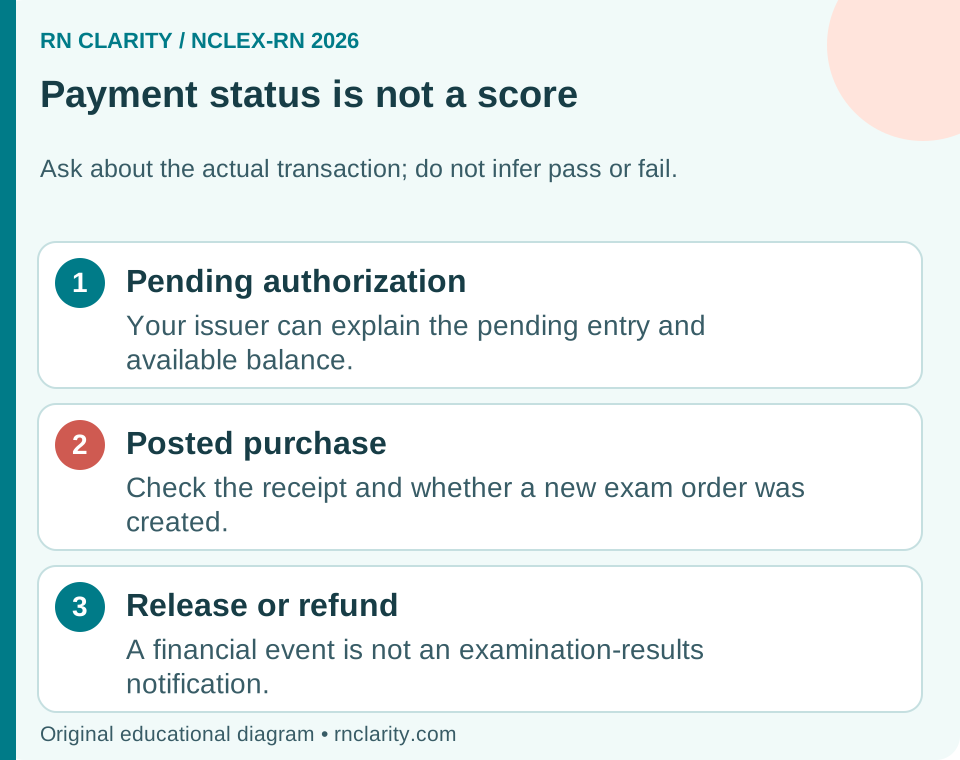
In general, card authorization is a payment-system check involving the card issuer. It can affect available funds or credit before a final transaction is visible. A posted transaction is different from a pending entry, and a refund after a completed purchase is different from a release of an authorization. These distinctions are financial; none is a pass or fail result.
For example, your available balance might temporarily change without a finalized purchase appearing in the statement. Alternatively, a new exam registration might generate a completed charge and a receipt. The first situation requires clarification of a pending payment event. The second requires clarification of an actual order and applicable terms. It is not safe to promise that either will resolve automatically on a timetable taken from another candidate’s experience.
Primary financial source: the Consumer Financial Protection Bureau explanation of card authorization explains that card authorization relates to the account and available credit. It does not discuss NCLEX results or validate PVT.
If funds are important for rent, transport or another essential expense, that is another reason not to experiment with another exam purchase. An uncertain payment event can be stressful even when it later resolves. Protecting your money is a sensible part of protecting yourself during the waiting period.
8. The Hold-Charge Policy: What Is Actually Established?
There is no universal official “PVT hold-charge policy” established by the sources linked here. The documented NCLEX registration terms matter more than a prediction about an automatic reversal. Do not describe an exam-registration purchase as a harmless temporary hold unless the merchant and card issuer have confirmed that description for the specific event.
The NCLEX Candidate Bulletin addresses registration payment and non-refundable fees, including duplicate registrations. Its terms do not create an unofficial results service. Before submitting any legitimate examination purchase, read the current terms displayed for that purchase.
If someone says that a passing candidate is always refunded, ask for the policy rather than a screenshot of a refund. A refund screenshot shows one financial event. It does not establish a universal rule, the reason for the event, the result of the associated examination or the conditions that would apply to your account.
If you need to contact support, ask specific financial questions: Was a new order created? Is there an authorization only or a completed purchase? What is the transaction reference? What terms apply to this registration? Which organization can explain the pending entry? These questions can be answered from account records without anyone pretending to interpret your score.
Do not dispute your valid original examination fee simply to see whether the response reveals your result. If a transaction is genuinely unauthorized or incorrectly processed, follow the merchant and issuer’s procedures for that problem. Describe what actually happened. Keep the original exam fee and any later transaction distinct in your notes so that you do not accidentally challenge the wrong payment.
9. Quick Results: The Legitimate Unofficial Option
Quick Results is an official service for obtaining an unofficial pass or fail outcome where the service is available. That wording may sound contradictory, but it is straightforward: the service itself is legitimate, while the information it provides is not a licence or authorization to practise.
The Quick Results page gives the current availability description and fee. At the time checked for this guide, the listed price is US$7.95, with a charge only when results are available. Check the live page before purchasing because fees and service arrangements can change.
Start in the account used for the exam. Look for the actual Quick Results option rather than beginning another registration. Read the displayed information and purchase instructions. If the service is not offered or the result is not yet available, do not substitute a new exam-registration transaction for it.
Participation is determined by the nursing regulatory body associated with your registration. Your nationality, the country in which you attended nursing school or the location of your testing centre is not a reliable substitute for checking the regulator’s participation. A candidate living abroad may be applying to a US board; a candidate physically in the US may be applying through a different results arrangement.
When you receive the unofficial outcome, save it privately if you need a record. Then check the regulator’s instructions for official results and licensure. If your employer needs a licence number or verification, a Quick Results receipt cannot satisfy that requirement merely because it says pass.
10. Two Business Days Is Not a Guaranteed 48-Hour Deadline
Many candidates talk about “the 48 hours,” but that phrase should not override the service’s published wording. The official description is two business days. Do not promise that every candidate will see a result at exactly the same clock time two calendar days after leaving the testing centre.
A practical example is a candidate who tests close to a weekend or holiday. Counting two periods of twenty-four hours can lead to a different expectation from thinking in business days. This guide does not prescribe a universal release calculation for every jurisdiction, holiday or time zone. The account and the official service instructions are the appropriate places to confirm availability.
Use an expected checking window rather than a countdown that treats every extra minute as bad news. Decide in advance that you will check at a reasonable time, then return to normal activities if results are unavailable. Repeated refreshing does not accelerate scoring, board processing or a payment system.
If you are coordinating with family in another country, describe the uncertainty plainly. “I expect to check the service after the published waiting period, but availability is not a pass or fail clue” is more accurate than “I will definitely know at noon on Wednesday.” A realistic expectation prevents unnecessary alarm when another person’s timetable differs from yours.
This distinction also protects against misinformation in search results. A headline can use forty-eight hours as shorthand, but an instruction to spend money or make a career decision should use the actual service terms. Read beyond the headline before relying on a promised release time.
11. Official Results and Licence Verification
The examination outcome and the issuance of a nursing licence are related but distinct. Passing the NCLEX does not by itself prove that every education, identity, application or other regulatory requirement has been satisfied. The regulator is responsible for the licensing decision.
The NCLEX results guidance directs candidates to their nursing regulatory body for official results and describes a period of up to six weeks. It also explains that results are checked through more than one scoring stage. A registration-screen interpretation is not a substitute for that process.
When the regulator publishes your status, verify that the record belongs to you. Similar names, old records and incomplete searches can confuse candidates. Use the identifiers and instructions appropriate to the board’s public verification system without publishing private identification information in discussion groups.
If you do not find a licence immediately, do not label that absence a failure. Ask what the board’s own instructions say about examination results, application status and licence issuance. A missing record can only tell you that you have not verified a record through that search at that moment.
Before starting work in a regulated nursing role, confirm that you have the necessary active authorization for that jurisdiction. An unofficial pass, a hopeful pop-up or a friend’s interpretation cannot authorize practice. If an employer is arranging your start date, communicate the status you can document rather than the status you expect.
12. When Results Are Unavailable or on Hold
An unavailable result is not a score. Treat it as unavailable information until the responsible organization provides a meaningful status. Do not infer that delay means failure, that speed means success or that an administrative hold proves misconduct.
First, confirm that you are in the correct account and looking at the correct examination. Second, check the published availability conditions. Third, read any message for the specific action it requests. Fourth, use the named support pathway if there is a genuine account or administrative problem. Keep the question narrow enough that support can address it.
For a payment problem, provide the transaction date, merchant reference and relevant receipt through an appropriate secure channel. For a board application issue, provide the application identifier and the specific missing-document question. Do not send a collection of speculation about question difficulty, pop-ups and social-media predictions; those details can obscure the problem that needs resolution.
Avoid repeated calls to organizations that do not provide your official result. The official results guidance identifies the nursing regulator as the source. Contacting unrelated departments cannot create a score report, and an employee’s inability to answer does not mean the result is bad.
If a status message includes an instruction that you do not understand, preserve it accurately and ask for clarification. Do not paraphrase a neutral administrative message into “I failed.” Separating observation from interpretation is useful here in the same way that it is useful in clinical documentation.
13. Why Online Success Stories Cannot Give Your Personal Odds
Consider two people who saw a similar message and later passed. Their stories show that the message can precede a pass. They do not show that the message only precedes a pass, that it is displayed consistently or that it is useful for everyone who attempts another registration.
To calculate reliability, a study would need a clearly defined method, a meaningful sample, a recorded official outcome for each participant and a count of contradictory results. It would also need to state when the method was used and what account or payment conditions applied. Otherwise the group being counted is unclear.
Social-media reporting can miss important cases. Someone who feels reassured may post immediately, while someone who is confused may never return with an official outcome. A thread can also collect responses from different years and different website workflows. Those features make a thread useful for understanding candidates’ concerns, but weak for calculating your individual probability of passing.
Be cautious with precision. “It is 99 percent accurate” sounds more convincing than “it worked for me,” but it requires much stronger evidence. Without an identifiable dataset and a reproducible calculation, the precise number should not be treated as a measurement.
You do not need a statistical argument to give yourself permission to hope. Hope and certainty are different. You can hope that your preparation was enough while refusing to let an unvalidated checkout experiment determine your mood, finances or professional plans.
14. Worked Scenario: A Blocked Registration After 85 Questions
Maya finishes an NCLEX-RN examination that stopped at 85 questions. A friend tells her to attempt another registration. She sees a message that prevents completion and is told she has definitely passed. She now has two observations: the examination stopped at the minimum item count, and a later registration attempt was blocked.
Neither observation reports her outcome. The first concerns exam administration; the second concerns a registration process. Putting them together does not automatically produce a valid score interpretation. Two ambiguous signals do not become authoritative merely because they point toward the result she hopes for.
Maya’s next useful action is to stop experimenting and follow the legitimate results route. She checks whether her board participates in Quick Results, sets a sensible checking window and keeps her examination records private. If she needs to tell her family something, she says that the exam is complete and the result is pending.
When the unofficial result later becomes available, she can act on that information at the level it supports. A pass can justify checking the next licensing step; it does not justify representing herself as licensed before verifying authorization. A fail can justify reading the regulator’s retake instructions; it does not justify concluding that all her nursing learning was worthless.
The lesson is not that Maya must feel pessimistic. It is that reassurance should be grounded in what she controls: she prepared, completed the examination and has a safe plan for the next step. The website message does not need to carry a promise it cannot establish.
15. Worked Scenario: A Pending Card Entry
Daniel attempts PVT and receives a banking notification. His app shows a pending entry. One commenter says this proves failure; another says it always disappears for passing candidates. Daniel is tempted to run the transaction again with another card to see which prediction is correct.
The immediate problem is financial ambiguity, not examination interpretation. Daniel should identify the exact transaction, whether a new registration was created and what his issuer means by pending. Repeating the transaction can add more entries without clarifying the first one.
He records the date and merchant reference, checks for a receipt and contacts the appropriate support service through a verified channel. He asks whether the entry is an authorization or a completed order and what process applies. He does not ask a bank employee to interpret his NCLEX score because the employee has information about his card, not his examination performance.
Meanwhile, Daniel follows the same results pathway he would have followed before the payment attempt. If the pending entry later disappears, that tells him about the financial event. If it posts, that tells him about a purchase. In either case, the actual pass or fail result must come from the designated service or regulator.
This scenario demonstrates why the advice “you have nothing to lose” is poor advice. A candidate may temporarily lose access to funds, create a duplicate registration or spend substantial time resolving a transaction. Even when the outcome is financially reversible, the stress and administrative work are real.
16. Worked Scenario: A Card Decline and No Results Yet
Aisha uses an altered card detail after watching a tutorial. The payment is declined, and the video says a decline belongs to one pop-up category. She is unsure whether the message means she passed or failed. The information she entered has introduced a new reason for the payment to be unsuccessful.
A failed payment cannot distinguish a score outcome from a payment-input problem. Even a valid card can be declined for account or technical reasons; deliberately changing details makes the observation still less useful. The responsible conclusion is that the payment attempt did not provide a result.
Aisha stops entering payment information. She checks the correct results option when eligible and asks for account help only if her original registration has a genuine problem. If she has shared screenshots, she removes private details before keeping any public version. She does not need to prove which pop-up category applies.
The practical teaching point is to avoid making the measurement unreliable and then interpreting its output as precise. If you wanted to assess a patient’s temperature, you would not intentionally misuse the device and then treat the reading as definitive. A registration checkout is not a thermometer for examination performance in the first place.
For future reference, Aisha writes a simple rule: if a process requests money for a new exam, treat it as a purchase decision, not a results check. That rule is easy to remember and protects her from a more complicated experiment during an already stressful period.
17. Worked Scenario: Quick Results Say Pass, No Licence Appears
Luis purchases legitimate Quick Results and sees pass. He searches the board’s verification system and does not yet find an active licence. His friend suggests that the Quick Results result may have been wrong because the public record is missing.
That conclusion combines two processes that may have different requirements. The unofficial exam result concerns the examination. Licence issuance concerns the board’s overall application decision. Luis should check the regulator’s application instructions and any outstanding requirements rather than replacing the pass with a prediction from a missing search result.
He confirms that he used the correct search method and then asks the board about application status if its instructions indicate that an inquiry is appropriate. He keeps the question factual: the examination result is available, and he wants to know whether additional licensing steps remain. He avoids sending private account screenshots to a public group.
Until authorization is verified, Luis does not start regulated nursing duties solely on the basis of the unofficial result. If he has an employer, he shares the status accurately and asks what verification the employer requires. That approach preserves confidence without overstating the document he has.
This is why the final checkpoint in the results pathway is licence verification. It is not an extra hurdle invented by a study guide. It is the distinction between passing an examination and meeting all conditions necessary for practice in a jurisdiction.
18. A Practical Waiting-Window Routine
Make a short plan for the period after the examination. It does not need to become another study schedule. Its purpose is to keep the day manageable while information is pending. Choose one results-checking time, one person to update and one activity that takes you away from screens.
During the first part of the waiting window, eat, rest and return to ordinary tasks. If you feel compelled to reconstruct every answer, remind yourself that memory after a long examination is incomplete. Avoid sharing actual examination items. You can talk about your feelings and preparation process without distributing protected exam content.
When the published results window approaches, check the legitimate service. If information is unavailable, write down that status once and return to your plan. Do not turn every refresh into a fresh interpretation. A neutral status should remain neutral until reliable information changes it.
If anxiety is disrupting sleep or daily functioning, reach out to a trusted person or an appropriate health professional. A study website cannot diagnose or treat that distress. It can help you reduce avoidable triggers, including payment experiments, countdown promises and repeated exposure to contradictory predictions.
Keep the routine flexible. A candidate with caregiving duties may need a different plan from someone who has taken time off. The useful principle is the same: make room for uncertainty without letting it dictate every action. Waiting for results is a period of limited information, not a requirement to keep yourself under constant examination.
19. How to Talk About Results With Family and Employers
Clear communication can reduce pressure from people who mean well. Before results are available, use a sentence that identifies the completed step and the pending step: “I completed the exam, and I am waiting for the published results service.” You do not need to include your question count, a payment screen or a prediction.
If a relative asks why another candidate already knows, explain that accounts, regulators and availability can differ. You do not need to compare every detail of someone else’s timeline. The person asking is usually trying to understand what happens next, so answer that question directly.
If an employer asks for a start date, distinguish a hoped-for date from a confirmed authorization. Say what documents you have and what verification remains. Avoid language that could imply you are already licensed when you have only an unofficial examination result. Accurate status reporting protects both you and the employer.
After an unfavorable result, you can keep the message brief: “The result was not a pass. I am reviewing the official performance report and the board’s next steps.” You do not owe everyone a detailed explanation of your preparation, finances or emotional reaction. Choose the people who can offer practical support.
After a favorable result, allow yourself to celebrate the examination achievement while completing the remaining licensing steps. Celebration does not require a claim beyond what is documented. A clear distinction between exam success and licensure also helps future candidates understand the process more accurately.
20. If the Official Result Is Not a Pass
Do not use an earlier PVT outcome to argue with a result document. Instead, read the regulator’s instructions and the Candidate Performance Report if one is provided. The report can help you identify broad areas for remediation; it should not be replaced by a remembered question or the final item on your examination.
Build a review plan around learning behavior. Ask whether you consistently recognized important cues, distinguished unstable from stable situations, selected safe interventions and evaluated outcomes. Review rationales for both correct and incorrect options. A useful error log records the reasoning error and the next action, not only the topic name.
Check retake eligibility with the regulator before paying for another attempt. Do not assume that a new registration alone makes you eligible or that every jurisdiction applies identical requirements. Budget for the actual official steps and avoid purchasing a retake because a social-media prediction frightened you before results were available.
Use study resources as practice tools, not as promises. A question bank can help you rehearse decision making, but its percentage does not become an NCLEX score. Repeatedly solving remembered questions can also create an appearance of improvement without showing that you can reason through a fresh case.
Go deeper: Build a focused remediation routine with the NCLEX study-plan guide and clinical-judgment overview.
21. How This Relates to the 2026 NCLEX-RN Test Plan
The 2026 test plan concerns entry-level nursing practice and the content and judgment assessed in the examination. It does not endorse PVT. Understanding that boundary keeps preparation focused on nursing decisions rather than website behavior.
When you return to studying, organize learning around the plan’s Client Needs areas and clinical judgment. For a practice case, identify the relevant patient information, explain why it matters, choose a defensible priority and evaluate whether the proposed action addresses the problem. These are meaningful learning tasks regardless of the length of your eventual examination.
Do not turn the test plan into another set of outcome myths. A certain number of medication items, a difficult-looking case or a question about delegation does not reveal whether you passed. Content distribution and individual performance are different questions. The experience of one candidate’s exam cannot serve as a personal scoring key for another.
Use the official 2026 RN Test Plan as the organizing reference. Read RN Clarity’s complete NCLEX-RN 2026 guide for a broader study explanation. The article you are reading serves a narrower purpose: helping you navigate the period after testing without mistaking registration or payment events for examination results.
That is a useful form of preparation too. A clear results plan can prevent avoidable spending and misinformation. It cannot change the outcome of an examination already taken, but it can help you handle the next decision with better evidence.
22. Frequently Asked Questions
Is the Pearson VUE Trick accurate in 2026?
The official sources cited here do not establish PVT as a validated results service. An anecdote can describe one candidate’s experience but cannot determine your result. Use legitimate Quick Results where available or the regulator’s official results pathway. Do not pay for another exam simply to test a prediction.
What does the good pop-up look like?
Candidates generally use that phrase for a registration-blocking message, but wording and circumstances can vary. RN Clarity does not provide an invented universal screenshot. A blocked registration is a registration outcome, not an official pass notification. Wait for information that explicitly reports your examination result.
Does a bad pop-up mean I failed?
No such conclusion is justified from the label alone. People apply it to several different payment or registration experiences. A card decline, a payment form and a completed purchase are not equivalent events, and none substitutes for your examination result. Resolve a financial problem separately if one occurred.
Will a PVT charge automatically be refunded if I passed?
Do not assume that. There is no universal PVT refund promise established by the official guidance linked in this article. Duplicate exam registrations can involve non-refundable fees. Ask the merchant and your issuer about the actual transaction rather than using another person’s refund timeline as a policy.
Should I use an incorrect card expiration date?
No. Altering payment details creates another reason for a transaction to fail and cannot make the response a validated score interpretation. It may leave you with an account or financial issue to resolve. Use the real results service rather than experimenting with checkout information.
Are Quick Results available exactly 48 hours after the exam?
The official service describes two business days, not a guaranteed universal forty-eight-hour deadline. Participation and actual availability matter. Follow the instructions shown for your registration. A delay or an unavailable result does not establish failure, and repeatedly refreshing the page does not accelerate the process.
Can candidates testing outside the US use Quick Results?
Check the results arrangement for the US nursing regulatory body associated with your application. Do not determine availability solely from nationality or testing-centre location. The official Quick Results page lists participating regulators. If the service is not offered for your registration, follow the regulator’s instructions instead.
Can I practise nursing after an unofficial pass?
An unofficial pass does not authorize practice. Verify that the relevant regulator has issued the authorization required for your role and jurisdiction. Education, identity and other application requirements can be separate from passing the exam. An employer may also need to verify your active licence independently.
What should I do if I already paid for another registration?
Stop experimenting. Preserve the receipt, transaction reference and relevant account messages privately. Identify whether you created a new order or are seeing a pending payment event. Ask the appropriate support service about that transaction and its terms. Continue to obtain your result through the legitimate results pathway.
Does stopping at 85 questions make PVT more reliable?
Question count does not validate a payment experiment. The examination can stop at the minimum length for different outcomes. Read NCLEX stopped at 85 questions to understand what the stopping rules do and do not tell you, then wait for your actual result.
23. References and Source Notes
Policy details were checked against the following primary sources on October 4, 2026. Links provide the current authoritative instructions; fees, participation and administrative requirements can change. Candidate scenarios, explanations and diagrams in this article are original educational material, not actual examination items or authenticated screenshots of a candidate account.
- NCSBN: 2026 NCLEX-RN Test Plan — examination content and administration reference.
- NCLEX: Quick Results — availability, participating regulators, unofficial status and current fee.
- NCLEX: Results — official results pathway and licence-related boundaries.
- NCLEX: Registration — registration and duplicate-registration warnings.
- NCLEX: Frequently Asked Questions — account, eligibility and administrative questions.
- Pearson VUE: NCLEX Candidate Bulletin — registration and payment terms; use the current bulletin linked by the provider.
- Pearson VUE: NCLEX contact information — legitimate account and administrative support channels.
- CFPB: Credit-card authorization explanation — payment authorization, not examination scoring.
The most useful next step is the one supported by the evidence you actually have: obtain the result, verify the licence and address any payment problem as a payment problem.