NCLEX-RN® Dosage Calculations: A Step-by-Step Nursing Math Guide
Learn NCLEX® dosage calculations step by step, including tablets, liquids, weight-based doses, IV rates, drops per minute, conversions, and safety checks.
postNumber: 76 title: "NCLEX-RN® Dosage Calculations: A Step-by-Step Nursing Math Guide" h1: "NCLEX-RN® Dosage Calculations: A Step-by-Step Nursing Math Guide" slug: "nclex-rn-dosage-calculations-nursing-math-guide" canonicalUrl: "https://rnclarity.com/blog/nclex-rn-dosage-calculations-nursing-math-guide" primaryKeyword: "NCLEX® dosage calculations" secondaryKeywords:
- "nursing dosage calculations"
- "NCLEX® nursing math"
- "medication calculation formulas"
- "IV flow rate calculations"
- "dimensional analysis nursing" metaTitle: "NCLEX® Dosage Calculations: Nursing Math Guide" metaDescription: "Learn NCLEX® dosage calculations step by step, including tablets, liquids, weight-based doses, IV rates, drops per minute, conversions, and safety checks." excerpt: "A plain-language nursing math guide that teaches safe setup, unit cancellation, reasonableness checks, and common NCLEX® dosage calculation types." suggestedPublishDate: "2026-08-01" status: "draft_nurse_review_required" schemaTypes: ["BlogPosting", "FAQPage", "BreadcrumbList"] diagramCount: 5 clinicalReview: "Required before publication"
NCLEX-RN® Dosage Calculations: A Step-by-Step Nursing Math Guide
Quick answer: Safe dosage calculation is not about memorizing dozens of formulas. It is about identifying what is ordered, finding what is available, keeping units consistent, calculating carefully, and checking whether the answer is realistic before giving a medication.
Editorial status: This is a complete educational draft. A qualified U.S. registered nurse or nurse educator should clinically review it before publication. Drug doses, facility procedures, and emergency algorithms must be checked against the current source and local policy.
Suggested reading time: 18–22 minutes
Designed for: NCLEX-RN® candidates, including internationally educated nurses and repeat test-takers.
Table of contents
- Start with the universal safety sequence
- Essential conversions and notation safety
- Tablets, capsules, and liquid medications
- Weight-based and safe-dose-range calculations
- IV pump rates and infusion time
- Gravity flow rates and drops per minute
- Insulin, heparin, and high-alert calculations
- Rounding, reasonableness, and double-checks
- A simple NCLEX® clinical-judgment workflow
- Original practice scenarios with rationales
- Common NCLEX® traps
- What to memorize and what to understand
- A seven-day review plan
- Frequently asked questions
- Final rapid-review checklist
Why this topic matters for the NCLEX-RN®
Dosage questions test more than arithmetic. They test whether you can convert a provider order into a safe nursing action. A candidate may know the clinical reason for a medication and still miss the question because the units are different, the answer is rounded incorrectly, or the final number is not checked against the dose range. In real practice, calculation errors can cause serious harm, so the NCLEX-RN® expects a safety-first approach.
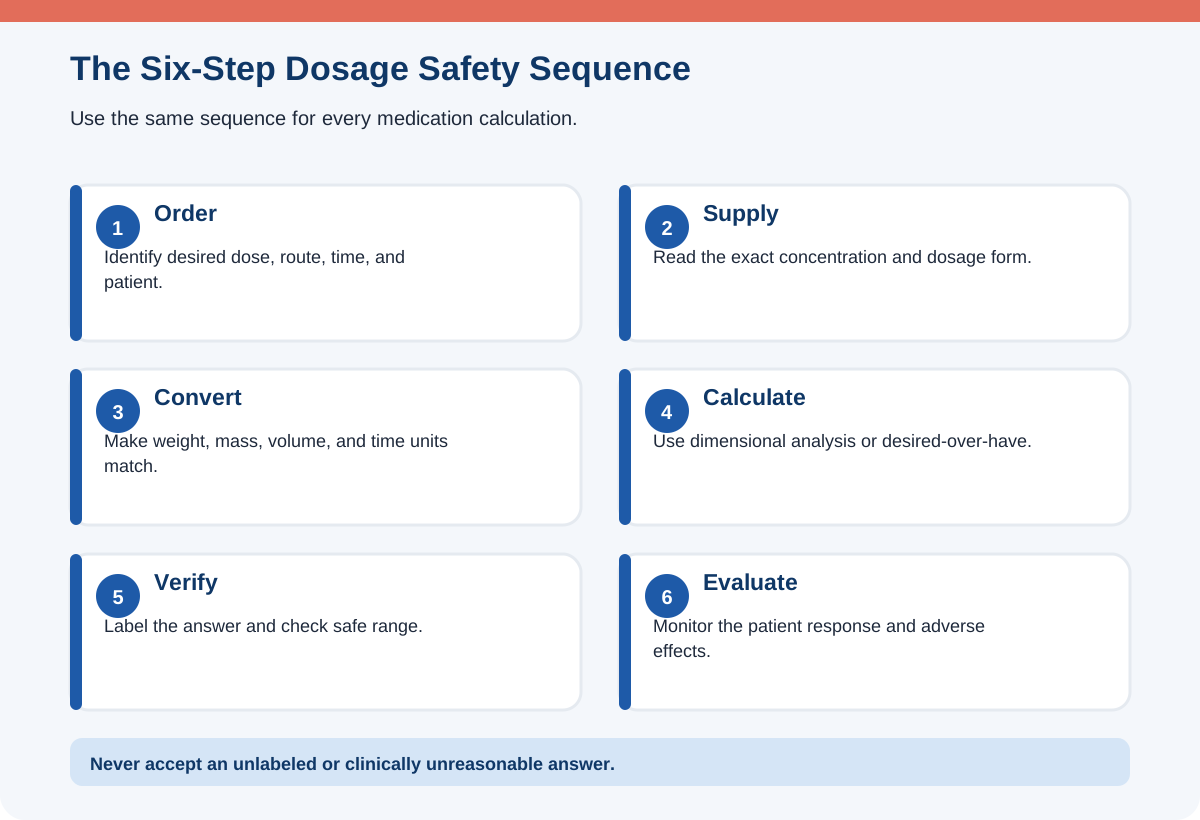
The strongest students use the same sequence every time. They write the ordered dose, write the dose supplied, attach units to every number, calculate, label the answer, and then ask, “Does this make sense?” This method works for tablets, liquid medications, weight-based orders, infusion pumps, gravity tubing, and intake calculations. The goal of this guide is to make that sequence automatic without turning nursing math into a collection of confusing shortcuts.
Start with the universal safety sequence
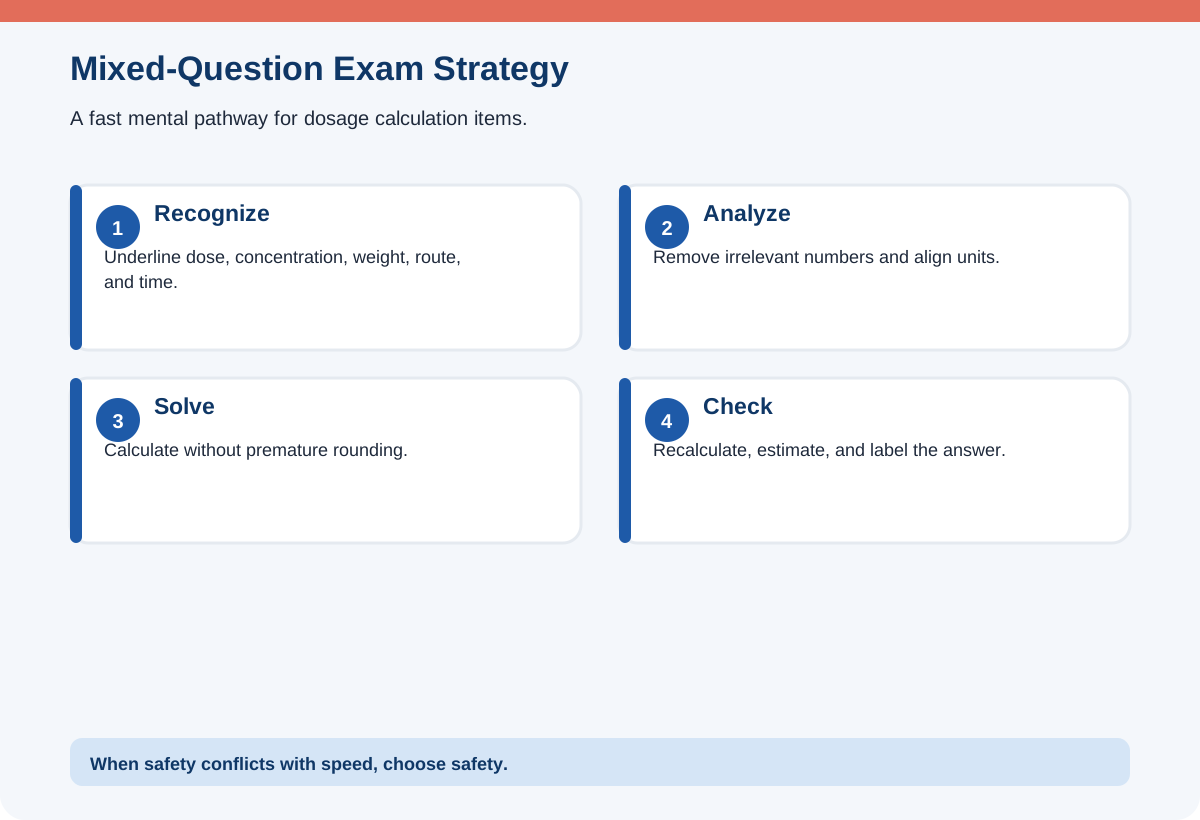
Use one repeatable sequence for every calculation. First, identify the dose or amount that the patient should receive. Second, identify what concentration or form is available. Third, make the units match. Fourth, calculate. Fifth, write the final unit. Sixth, check the answer against the order, the safe range, the patient’s condition, and normal clinical sense.
A helpful relationship is desired dose divided by dose on hand, multiplied by the quantity that contains the dose on hand. For example, if 500 mg is ordered and each tablet contains 250 mg, the patient needs 500 ÷ 250 × 1 tablet, which equals 2 tablets. Dimensional analysis reaches the same answer by arranging conversion factors so unwanted units cancel. Either method is acceptable when used correctly. Choose the method that you can perform consistently under pressure.
Never calculate from memory while ignoring the label. The wording “250 mg per 5 mL” means the whole 5 mL contains 250 mg. It does not mean 250 mg per 1 mL. Read the concentration as a relationship and preserve that relationship in the calculation.
Essential conversions and notation safety
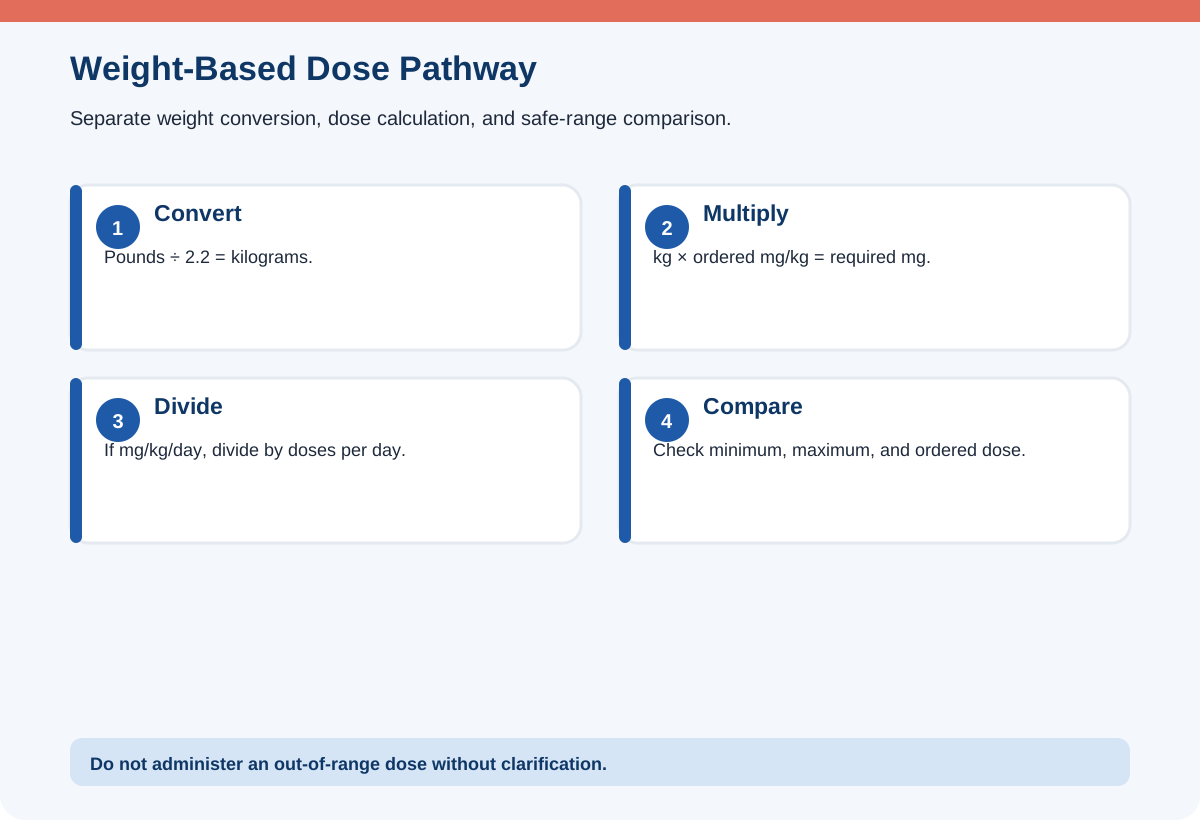
Most nursing calculations use a small set of metric relationships. One kilogram equals 1,000 grams. One gram equals 1,000 milligrams. One milligram equals 1,000 micrograms. One liter equals 1,000 milliliters. For body weight, one kilogram is approximately 2.2 pounds. Convert pounds to kilograms by dividing by 2.2, and convert kilograms to pounds by multiplying by 2.2.
Write a leading zero for a value smaller than one, such as 0.5 mg. Do not write a trailing zero after a whole number, such as 5.0 mg, because a misplaced decimal could be interpreted as 50 mg. Keep the unit attached to the number throughout the work. A bare answer such as “2” is incomplete; the answer may be 2 tablets, 2 mL, 2 units, or 2 mL/hour.
Do not mix measurement systems unless the question requires it. When a weight-based order is written in mg/kg and the weight is in pounds, convert the weight to kilograms before multiplying. When the concentration is in mg/mL, make sure the ordered dose is also in milligrams before dividing.
| Conversion | Relationship | Safe way to think |
|---|---|---|
| Mass | 1 g = 1,000 mg; 1 mg = 1,000 mcg | Move three decimal places for each metric step |
| Volume | 1 L = 1,000 mL | Keep liters and milliliters consistent |
| Weight | 1 kg ≈ 2.2 lb | lb ÷ 2.2 = kg |
| Time | 1 hour = 60 minutes | Convert before calculating drops/minute |
| Notation | 0.5, not .5; 5, not 5.0 | Protect against tenfold errors |
Tablets, capsules, and liquid medications
For solid medications, divide the ordered dose by the strength of one tablet or capsule. If the answer is a fraction, consider whether the dosage form can safely be divided. A scored immediate-release tablet may sometimes be split, but an enteric-coated, extended-release, or capsule product generally should not be crushed or divided unless the product information specifically permits it. On an exam question, a calculated answer that requires an impossible dosage form should make you pause and clarify.
For liquids, use the full concentration relationship. Suppose 375 mg is ordered and the bottle states 250 mg per 5 mL. Set up 375 mg × 5 mL ÷ 250 mg. The milligrams cancel, leaving 7.5 mL. The final answer should include mL and should be measured with an appropriate device. Very small volumes may require an oral syringe rather than a medicine cup.
When reconstitution is involved, use the concentration after reconstitution, not the amount of dry medication in the vial. The label or question will state the final concentration, such as 500 mg/mL after adding the specified diluent. Do not invent a concentration from the vial size.
Weight-based and safe-dose-range calculations
Weight-based orders usually follow two steps: find the patient’s weight in kilograms, then multiply by the prescribed amount per kilogram. If a child weighs 44 lb, the weight is 44 ÷ 2.2 = 20 kg. An order for 10 mg/kg therefore equals 200 mg per dose. If the order is written as mg/kg/day divided into several doses, calculate the total daily amount first and then divide by the number of doses.
A safe-dose-range question asks whether the prescribed dose falls within an acceptable range. Calculate the minimum and maximum dose using the same patient weight. Then compare the ordered dose with that interval. Do not “fix” an unsafe order by independently changing it. The nursing action is to hold or delay as appropriate, recheck the calculation and source, and clarify the order according to policy.
Pay attention to whether a range is per dose or per day. A safe range of 20–40 mg/kg/day divided every six hours is not the same as 20–40 mg/kg per dose. Four doses per day may create a fourfold error if the wording is missed.
IV pump rates and infusion time
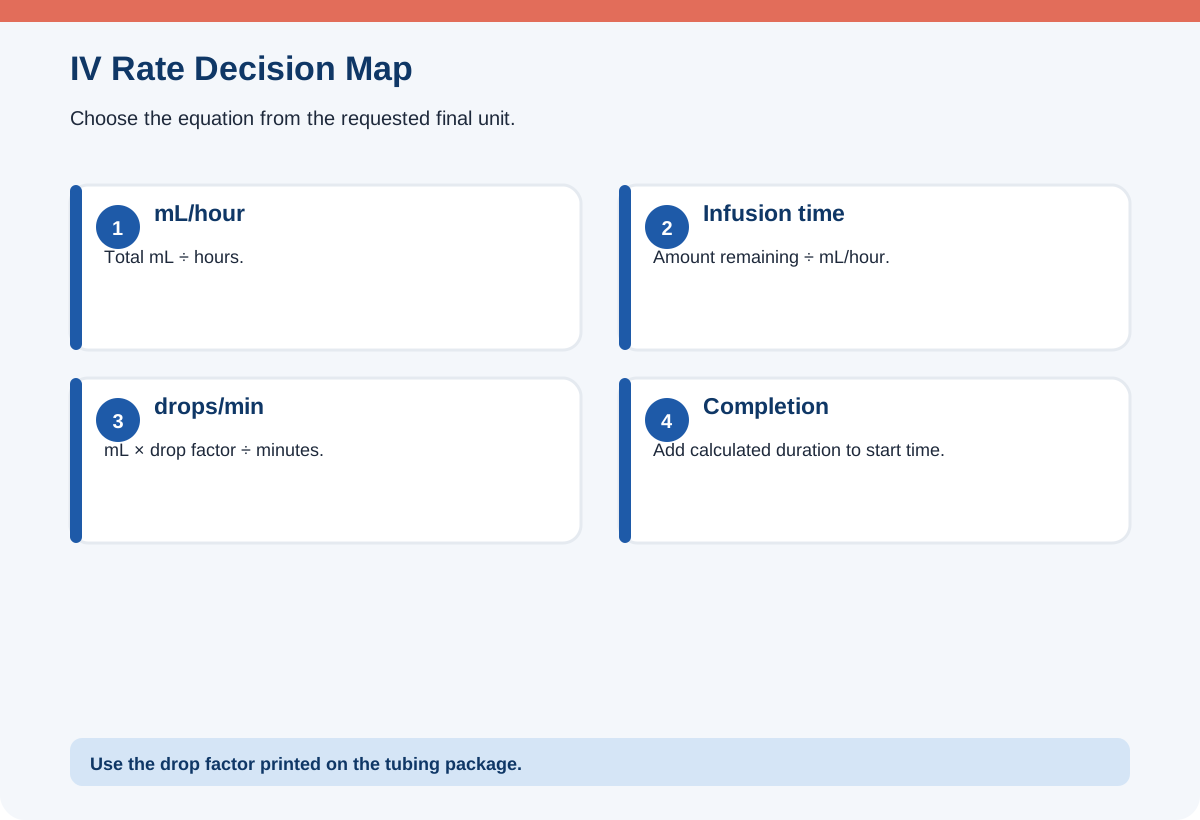
An infusion pump commonly requires milliliters per hour. Divide the total volume by the number of hours. A 1,000 mL bag that must infuse over 8 hours is programmed at 125 mL/hour. If the time is given in minutes, convert it to hours or use a proportion carefully. For example, 100 mL over 30 minutes equals 200 mL/hour because 30 minutes is 0.5 hour.
To find infusion time, divide the amount remaining by the current rate. If 300 mL remains and the pump runs at 75 mL/hour, the infusion will take 4 hours. To predict a completion time, add the duration to the current clock time while accounting for the 24-hour clock when necessary.
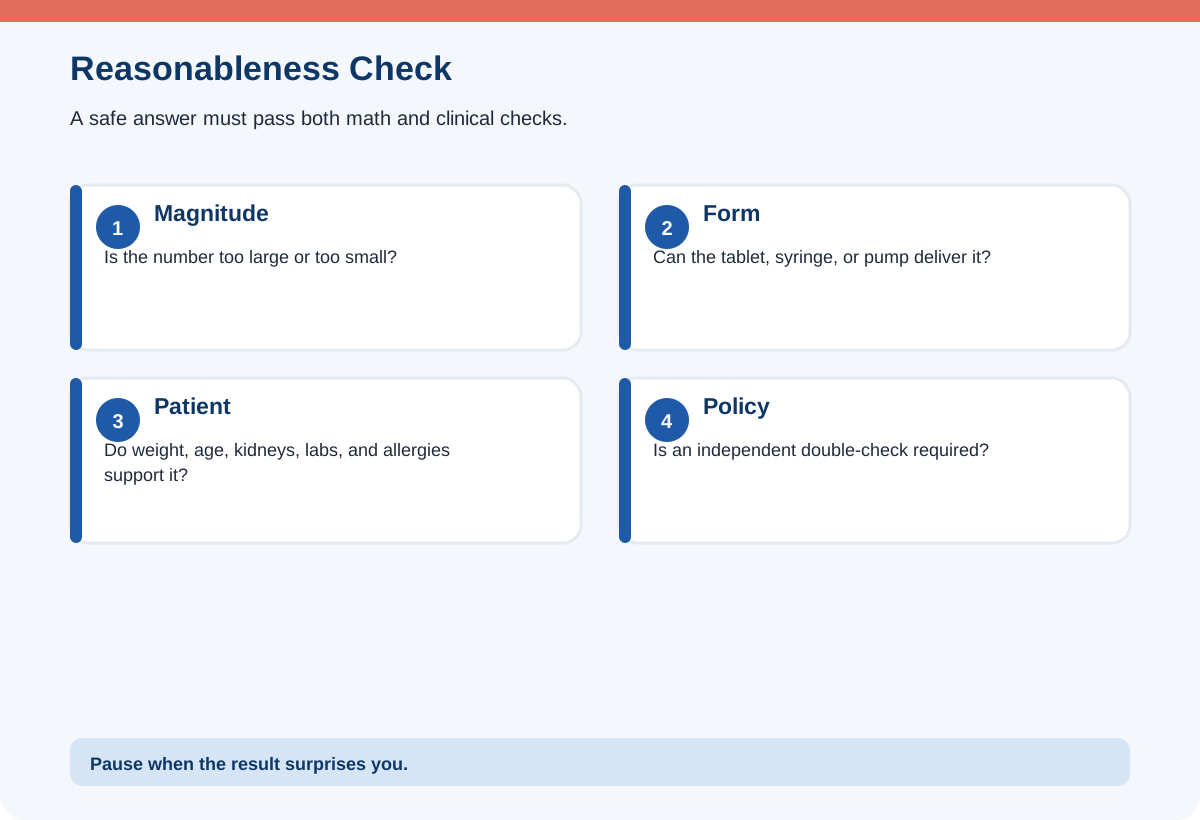
A pump setting is not automatically safe merely because the arithmetic is correct. Verify the medication concentration, prescribed dose, pump library, route, line compatibility, and patient-specific limits. High-alert continuous infusions often require an independent double-check and a standardized concentration.
Gravity flow rates and drops per minute
When an IV is regulated manually, the answer is often drops per minute. Use total volume in mL multiplied by the tubing drop factor in drops/mL, divided by total time in minutes. The drop factor is printed on the tubing package and may be 10, 15, 20, or 60 drops/mL. Microdrip tubing is commonly 60 drops/mL, but use the value provided in the question rather than assuming.
Because drops are counted as whole drops, a drops-per-minute answer is generally rounded to the nearest whole number unless the question gives another instruction. A calculation of 31.6 drops/minute becomes 32 drops/minute. Do not round the time or intermediate numbers too early, because repeated rounding can change the final result.
After setting the rate, reassess the site, patient, and remaining volume. Gravity flow can change when the patient moves, the bag height changes, or resistance develops. The nurse’s responsibility continues after the initial calculation.
Insulin, heparin, and high-alert calculations
Insulin is measured in units, not milligrams. Use an insulin syringe that matches the concentration and verify the exact insulin type, dose, timing, blood glucose, meal plan, and route. Do not use “U” as an abbreviation for units in handwritten medication communication because it can be mistaken for a zero. Mixing rules, correction scales, and pump settings should follow the exact order and facility protocol.
Heparin infusions may require a bolus, a units-per-hour rate, or a dose adjustment based on a laboratory result and protocol. A bag might contain 25,000 units in 500 mL, which equals 50 units/mL. An order for 1,000 units/hour would therefore require 20 mL/hour. Keep units visible: 1,000 units/hour × 1 mL/50 units = 20 mL/hour.
These drugs deserve extra caution because a small calculation or programming error can have a large effect. On the NCLEX®, the safest answer often includes checking the current patient data, using the approved protocol, obtaining an independent double-check when required, and monitoring for the expected therapeutic and adverse effects.
Rounding, reasonableness, and double-checks
Follow the rounding direction in the question. If none is given, use common nursing conventions while recognizing that organizations may specify their own rules. Tablets may be rounded only to a portion that the dosage form can deliver. Liquid medications may be measured to the nearest tenth or hundredth depending on the volume and device. Pump rates are often programmed to a whole number or decimal supported by the pump. Drops per minute are whole numbers.
A reasonableness check catches many errors. If one tablet contains 500 mg and the order is 250 mg, an answer of 5 tablets is clearly too large. If a child weighs 22 lb, a calculated weight of 48.4 kg is clearly wrong because the direction of conversion was reversed. Estimate first: 22 lb is about 10 kg.
For high-alert medications, the “double-check” should be independent when policy requires it. Two nurses should calculate or verify separately rather than one nurse reading an answer and the other agreeing. On the exam, never allow urgency to erase medication rights, allergy checks, or a dangerously unusual dose.
A simple NCLEX® clinical-judgment workflow
Recognize the order, available concentration, route, timing, patient weight, allergies, relevant laboratory values, and any maximum dose. Analyze whether the units match and whether the clinical data make the dose appropriate. Prioritize any risk for overdose, underdose, hypoglycemia, bleeding, respiratory depression, renal accumulation, or incompatible route. Generate a calculation and a separate safety plan. Take action only after verifying the result and required checks. Evaluate the patient’s response, not merely whether the pump is running.
When a question gives extra data, do not assume every number belongs in the equation. A patient’s age or room number may be irrelevant, while creatinine, weight, blood glucose, or the concentration on the label may be essential. Clinical judgment means selecting the numbers that change safety.
Original practice scenarios with rationales
These are original educational examples written for RN Clarity. They are not copied, recalled, or represented as actual NCLEX® questions.
Scenario 1: Liquid antibiotic
A prescription calls for 600 mg of a liquid medication. The available concentration is 400 mg per 5 mL. How many milliliters should the nurse prepare?
Best response: 7.5 mL.
Rationale: 600 mg × 5 mL ÷ 400 mg = 7.5 mL. The ordered and supplied milligram units cancel, leaving milliliters.
Why the alternatives are weaker: 1.5 mL results from dividing without preserving the 5 mL quantity. Thirty mL is much larger than expected and reflects multiplication in the wrong direction.
Scenario 2: Pediatric safe range
A child weighs 33 lb. The safe dose is 10–15 mg/kg per dose. The order is 250 mg per dose. What should the nurse do?
Best response: Recognize that the order is above the calculated safe range and clarify it before administration.
Rationale: 33 lb ÷ 2.2 = 15 kg. The safe range is 150–225 mg per dose. The ordered 250 mg is above the maximum.
Why the alternatives are weaker: Giving 250 mg because it is close ignores the upper limit. Independently reducing it to 225 mg changes a provider order without clarification.
Scenario 3: IV pump rate
An order requires 250 mL to infuse over 2.5 hours. What pump rate is needed?
Best response: 100 mL/hour.
Rationale: 250 mL ÷ 2.5 hours = 100 mL/hour.
Why the alternatives are weaker: 62.5 mL/hour treats 2.5 hours as four hours. A drops-per-minute calculation is unnecessary because a pump rate is requested.
Scenario 4: Gravity tubing
A nurse must infuse 500 mL over 4 hours using tubing calibrated at 15 drops/mL. What is the approximate flow rate?
Best response: 31 drops/minute.
Rationale: 500 × 15 ÷ 240 minutes = 31.25, rounded to 31 drops/minute.
Why the alternatives are weaker: 125 is the mL/hour rate, not the drops/minute rate. Using four as minutes creates a dangerously high result.
Scenario 5: Heparin concentration
A heparin bag contains 25,000 units in 500 mL. The prescribed rate is 1,250 units/hour. What pump setting is required?
Best response: 25 mL/hour.
Rationale: The concentration is 50 units/mL. 1,250 units/hour ÷ 50 units/mL = 25 mL/hour.
Why the alternatives are weaker: 50 mL/hour would deliver 2,500 units/hour. 2.5 mL/hour reflects a decimal-place error.
Common NCLEX® traps
- Unit mismatch. Converting the number but not the unit can create a thousandfold error.
- Pounds treated as kilograms. Always divide pounds by 2.2 before using a mg/kg order.
- Daily dose confused with dose per administration. Read “per day” and “divided doses” literally.
- The quantity is dropped. A label of 250 mg per 5 mL requires the 5 mL in the equation.
- Rounding too early. Carry the calculation and round only the final answer.
- Impossible dosage form. Question a result that requires splitting or crushing a formulation that cannot be altered.
- No final unit. A number without tablets, mL, units, mL/hour, or drops/minute is unsafe.
- Correct arithmetic but unsafe patient. Always integrate allergies, labs, route, and maximum dose.
What to memorize and what to understand
Memorize the core metric conversions, pounds-to-kilograms relationship, one hour equals 60 minutes, and the gravity-flow formula. Understand why units cancel, why a safe range is calculated before giving a pediatric dose, and why high-alert medications require stronger verification. Memorization helps you start; understanding helps you detect an answer that is mathematically neat but clinically dangerous.
A useful mental estimate is as important as the exact answer. Know whether the result should be less than one tablet, several milliliters, tens of mL/hour, or hundreds of drops per minute. Estimates are not used for administration, but they are powerful error detectors.
A seven-day review plan
Day 1: Review metric conversions and write ten conversion problems. Day 2: Practice tablets and liquids while labeling every unit. Day 3: Practice pounds-to-kilograms, mg/kg per dose, and mg/kg/day questions. Day 4: Calculate pump rates, infusion time, and completion time. Day 5: Practice drop factors and whole-number rounding. Day 6: Work through insulin, heparin, and safe-range scenarios with independent reasonableness checks. Day 7: Complete a mixed set without notes, then review every setup—not only the wrong answers. Rewrite any missed question using dimensional analysis and the desired-over-have method to prove that both reach the same answer.
Frequently asked questions
Which dosage calculation method is best for the NCLEX®?
The best method is the one you apply accurately and consistently. Desired-over-have and dimensional analysis are both valid. Dimensional analysis is especially useful when several conversions are needed.
Will the NCLEX® provide formulas?
Do not rely on receiving a formula sheet. Learn the common relationships and read each item for provided concentrations, drop factors, ranges, and rounding directions.
Should I round during the calculation?
Keep extra decimal places during the work and round the final answer according to the question, dosage form, device, and safe practice.
What if my calculated dose looks unsafe?
Recheck the order, units, weight, concentration, maximum dose, and arithmetic. In practice, hold or delay as appropriate and clarify rather than guessing or independently changing the prescription.
Are brand names used on the NCLEX®?
The NCLEX® generally uses generic medication names. Learn drug classes and safety principles rather than relying only on brand-name recognition.
How many calculation questions should I practice?
Practice enough mixed problems that the setup becomes automatic. Quality matters more than a fixed count: review why the units cancel and why the final answer is clinically reasonable.
Final rapid-review checklist
- I can convert g, mg, mcg, L, mL, lb, kg, hours, and minutes.
- I keep units in every calculation.
- I can calculate tablets, liquids, mg/kg doses, and safe ranges.
- I can calculate mL/hour, infusion time, and drops/minute.
- I know when whole-number rounding is required.
- I perform a reasonableness check before accepting an answer.
- I treat insulin, heparin, and other high-alert calculations with extra caution.
- I clarify an unsafe or impossible dose rather than changing it myself.
Sources and further reading
- NCSBN, 2026 NCLEX-RN® Test Plan and candidate preparation resources: https://www.nclex.com/test-plans.page
- NCSBN, NCLEX® FAQs on medication names, reference ranges, and item expectations: https://www.nclex.com/faqs.page
- The Joint Commission, medication safety and prohibited abbreviation resources: https://www.jointcommission.org/resources/patient-safety-topics/medication-safety/
Educational disclaimer
RN Clarity provides educational study support only. This article is not medical advice, does not replace a nursing program, clinical instructor, employer policy, or current provider order, and is not affiliated with or endorsed by NCSBN, Pearson VUE, or the NCLEX-RN® program. In an actual clinical setting, follow current laws, facility policies, approved references, and the directions of the responsible licensed clinician.
Structured data
{
  "@context": "https://schema.org",
  "@graph": [
    {
      "@type": "BlogPosting",
      "headline": "NCLEX-RN® Dosage Calculations: A Step-by-Step Nursing Math Guide",
      "description": "Learn NCLEX® dosage calculations step by step, including tablets, liquids, weight-based doses, IV rates, drops per minute, conversions, and safety checks.",
      "mainEntityOfPage": {
        "@type": "WebPage",
        "@id": "https://rnclarity.com/blog/nclex-rn-dosage-calculations-nursing-math-guide"
      },
      "url": "https://rnclarity.com/blog/nclex-rn-dosage-calculations-nursing-math-guide",
      "datePublished": "ACTUAL_FIRST_LIVE_DATE",
      "dateModified": "ACTUAL_FIRST_LIVE_DATE",
      "author": {
        "@type": "Organization",
        "name": "RN Clarity"
      },
      "publisher": {
        "@type": "Organization",
        "name": "RN Clarity"
      },
      "inLanguage": "en-US",
      "isAccessibleForFree": true,
      "about": [
        "NCLEX-RN® examination",
        "Nursing education",
        "NCLEX® dosage calculations"
      ]
    },
    {
      "@type": "BreadcrumbList",
      "itemListElement": [
        {
          "@type": "ListItem",
          "position": 1,
          "name": "Home",
          "item": "https://rnclarity.com/"
        },
        {
          "@type": "ListItem",
          "position": 2,
          "name": "Blog",
          "item": "https://rnclarity.com/blog"
        },
        {
          "@type": "ListItem",
          "position": 3,
          "name": "NCLEX-RN® Dosage Calculations: A Step-by-Step Nursing Math Guide",
          "item": "https://rnclarity.com/blog/nclex-rn-dosage-calculations-nursing-math-guide"
        }
      ]
    },
    {
      "@type": "FAQPage",
      "mainEntity": [
        {
          "@type": "Question",
          "name": "Which dosage calculation method is best for the NCLEX®?",
          "acceptedAnswer": {
            "@type": "Answer",
            "text": "The best method is the one you apply accurately and consistently. Desired-over-have and dimensional analysis are both valid. Dimensional analysis is especially useful when several conversions are needed."
          }
        },
        {
          "@type": "Question",
          "name": "Will the NCLEX® provide formulas?",
          "acceptedAnswer": {
            "@type": "Answer",
            "text": "Do not rely on receiving a formula sheet. Learn the common relationships and read each item for provided concentrations, drop factors, ranges, and rounding directions."
          }
        },
        {
          "@type": "Question",
          "name": "Should I round during the calculation?",
          "acceptedAnswer": {
            "@type": "Answer",
            "text": "Keep extra decimal places during the work and round the final answer according to the question, dosage form, device, and safe practice."
          }
        },
        {
          "@type": "Question",
          "name": "What if my calculated dose looks unsafe?",
          "acceptedAnswer": {
            "@type": "Answer",
            "text": "Recheck the order, units, weight, concentration, maximum dose, and arithmetic. In practice, hold or delay as appropriate and clarify rather than guessing or independently changing the prescription."
          }
        },
        {
          "@type": "Question",
          "name": "Are brand names used on the NCLEX®?",
          "acceptedAnswer": {
            "@type": "Answer",
            "text": "The NCLEX® generally uses generic medication names. Learn drug classes and safety principles rather than relying only on brand-name recognition."
          }
        },
        {
          "@type": "Question",
          "name": "How many calculation questions should I practice?",
          "acceptedAnswer": {
            "@type": "Answer",
            "text": "Practice enough mixed problems that the setup becomes automatic. Quality matters more than a fixed count: review why the units cancel and why the final answer is clinically reasonable."
          }
        }
      ]
    }
  ]
}