Free classroom kit · Simulation & reflection

Simulation Prebrief & Debrief Kit

A facilitator opening script, role cards, observation grid, worked debrief and a learning-to-workplace reflection sheet.

45-minute sessionFree · No loginPDF + editable HTML
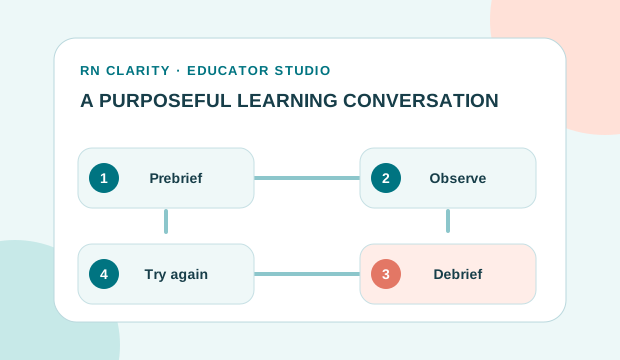
Original visual overview of Simulation Prebrief & Debrief Kit

What learners will do

Observable learning outcomes

  • State the simulation’s objective, roles and safety boundaries before it begins.
  • Describe observable behaviour without judging the person.
  • Turn a debrief insight into a specific action for the next attempt.

Suggested session flow

  1. 0–8 minUse the prebrief: objective, roles, fictional case, boundaries and pause process.
  2. 8–18 minRun one case from the clinical-judgment kit.
  3. 18–23 minAllow a short private reflection and gather observations.
  4. 23–38 minDiscuss the cue, decision, team communication and reassessment.
  5. 38–45 minPractise an improved handoff and commit to one transfer action.
Ready for learners

Learner handout

Complete the activity before opening the worked key.

Simulation Prebrief & Debrief Kit · Learner handout

RN Clarity · Free teaching kit · 2026 NCLEX-RN alignment

Prebrief · What learners need to know

This is a learning activity using a fictional patient, not an actual care assignment. The objective is to explain a cue-based decision, communicate a clear request and state reassessment evidence. Say what you can and cannot do with the equipment or scenario before it begins.

Roles: primary learner, assisting learner, observer and facilitator. Agree how to call a pause if an instruction is unclear, a participant needs support or a scenario safety issue arises. A pause in teaching does not substitute for the emergency process in real clinical care.

Observer card

ObserveRecord an example
Cue noticedWhich finding did the learner identify? ______
Reasoning explainedHow was the decision linked to evidence? ______
Help requestedWho was called, what was requested and how was urgency stated? ______
Message verifiedWas the important message repeated and confirmed? ______
Outcome checkedWhat was reassessed, and how was the result interpreted? ______

Private reflection before debrief

  • What was I trying to achieve?
  • Which cue changed my thinking?
  • What went well, with one example?
  • What was difficult or unclear?
  • What would I change on the next attempt?

Debrief questions

  • Describe what happened without adding facts that were not in the case.
  • What evidence supported the initial priority?
  • Which alternatives did you consider and why?
  • When did the plan need to change?
  • How did communication help or hinder the response?
  • Which new observation would show whether the action helped?
  • Choose one improvement and rehearse it now.

From classroom to practice

Learning insightPractice connectionBoundary / help needed
A trend matters more than an isolated label.Compare current observations with baseline and report a change.Use local escalation policy and supervision.
A request must be explicit.State what response is needed and how urgent it is.Use the communication process required in the setting.
A medicine list needs reconciliation.Clarify ingredients and discrepancies at transitions.Resolve the plan with the appropriate clinician/pharmacist.

Next-attempt commitment

Complete: “In the next fictional case, when ____, I will ____ and check ____.” Keep the plan observable and within the learner’s role.

For the educator

Open the facilitator key

Worked reasoning, misconceptions, feedback and adaptations.

Simulation Prebrief & Debrief Kit · Facilitator notes & worked key

Facilitator opening script

“Today we are practising how to recognise a changing cue, explain a priority and make a clear handoff. The patient and events are fictional. We will discuss observed decisions, not label people. Tell me if an instruction or equipment limit is unclear. Anyone can ask for a learning pause. We will review the same objective afterwards and choose one improvement to rehearse.”

Explain what the scenario will represent, what is unavailable, which actions must be verbalised and which are simulated. Use only equipment and supervision suitable for the activity. This kit supports classroom planning; it is not a replacement for an accredited simulation programme or local safety procedures.

Worked debrief · Deterioration case

Observation: the learner described the low oxygen saturation but initially omitted the new confusion and fall in BP. Start with description: “I heard the saturation in the handoff. I did not hear the change in alertness or BP.” Invite the learner’s reasoning: “What were you focusing on at that moment?”

Explore: “How do the other changes affect your concern? What information would the receiver need?” Compare a revised handoff with the original, then ask the learner to rehearse the shorter, complete message. Transfer: use a different case where a trend changes the priority. Do not conclude that one improved rehearsal establishes broad clinical competence.

Keep the debrief useful

Less usefulMore useful
“Why did you do that wrong?”“What were you noticing and trying to achieve?”
“You always miss cues.”“This handoff included the saturation but omitted two changes.”
A lecture after every responseAsk for reasoning, then give a short correction and a new rehearsal.
A general promise to do betterAgree one observable action and a follow-up opportunity.

Facilitator observation grid

Use descriptive notes: demonstrated with an example, demonstrated after a prompt, or not yet demonstrated in this activity. This grid is a teaching record, not a validated scale or a licence/competence decision. Keep formal learner records in the approved institution system. Do not enter identifiable records into the public tools.

Closing script

“What should we keep from today? What one thing will we change? Show me the revised handoff or decision now. Where will you practise the same principle in a different case? What support do you need?”

Close with a manageable next action. If discussion reveals distress, a real patient risk or an issue beyond the activity, follow the institution’s support and clinical escalation processes. Keep real patient details out of teaching downloads.

Take it into your classroom

Two copies. The key stays separate.

Print/save a branded PDF, or download a self-contained editable HTML lesson file. No account or email required.

Learner handout

Activities, questions and note spaces. No worked answer keys.

Facilitator pack

Learner activities plus worked keys, feedback and references.

Open the downloaded HTML in a browser, click the lesson text to edit, then choose “Save an edited copy”. For PDF, choose your browser’s Save as PDF destination. Custom planner entries are included.