Free classroom kit · Clinical judgment

Clinical Judgment Case Lab

Three unfolding adult cases with cue reveals, six-function learner prompts, worked facilitator keys and debrief questions.

45-minute sessionFree · No loginPDF + editable HTML
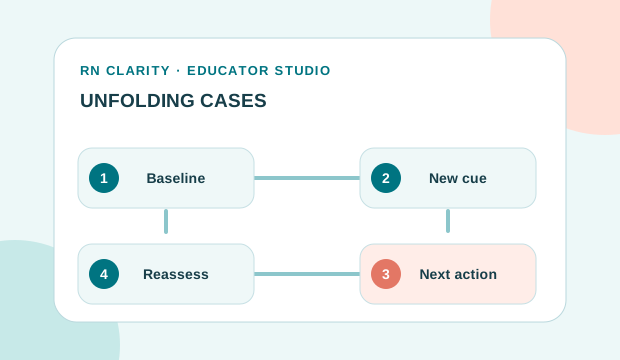
Original visual overview of Clinical Judgment Case Lab

What learners will do

Observable learning outcomes

  • Separate observed cues from assumptions and missing information.
  • Explain why a changing cue alters priority.
  • Choose a safe next action and define the evidence needed to evaluate it.

Suggested session flow

  1. 0–5 minSet the objective and learning boundaries. Assign a cue reader, reasoning lead and observer.
  2. 5–15 minRelease Case 1, pause for an individual decision, then discuss the change in condition.
  3. 15–25 minUse Case 2 to contrast safe swallowing with new reduced alertness.
  4. 25–35 minUse Case 3 for medicine reconciliation and teach-back.
  5. 35–45 minCompare reasoning, debrief and write one next-practice goal.
Ready for learners

Learner handout

Complete the activity before opening the worked key.

Clinical Judgment Case Lab · Learner handout

RN Clarity · Free teaching kit · 2026 NCLEX-RN alignment

How to use the case cards

All patients and events are fictional. Read one reveal at a time. Record the cue that supports your decision, the information you still need, your next action and how you would know whether it helped. Do not add unprovided findings. A possible explanation is not a confirmed diagnosis.

Case 1 · A change during pneumonia treatment

An adult, age 48, is being treated for pneumonia. Two hours ago the patient was alert, BP 118/72 mmHg, pulse 88/min, respiratory rate 18/min and oxygen saturation 96% on room air.

Reveal A: the patient is now newly confused. BP is 88/52 mmHg, pulse 122/min, respiratory rate 30/min, temperature 38.7°C and oxygen saturation 88% on room air. The patient says breathing feels harder. No new treatment orders or additional results are provided.

  • Recognise cues: select the three findings that most change your concern.
  • Analyse cues: explain the relationship between breathing, circulation and altered alertness.
  • Prioritise hypotheses: what urgent problem must be addressed before a routine teaching task? State what remains unconfirmed.
  • Generate solutions: identify immediate support, escalation and information needs.
  • Take action: describe your first action and who needs to hear what.
  • Evaluate outcomes: name at least three observations to reassess.

Case 1 · Reveal B

The urgent response team is present. Support is underway according to local orders and policy. Repeat BP is 104/66 mmHg, respiratory rate 24/min and oxygen saturation 94% on the prescribed oxygen support. The patient is still less alert than the earlier baseline.

  • Does the improving set of observations mean the problem is resolved? Why?
  • Which trend would make you escalate again?
  • Draft a 30-second handoff that distinguishes observed deterioration from a possible cause.

Case 2 · Insulin, a delayed meal and a changing ability to swallow

An adult, age 54, with diabetes received insulin, but breakfast was delayed. The patient is awake, pale and trembling. Capillary glucose is 54 mg/dL (3.0 mmol/L). BP is 124/76 mmHg, respiratory rate 18/min and oxygen saturation 98% on room air.

Reveal A: the patient can follow instructions. Before offering anything by mouth, you must check that swallowing is safe.

  • Identify the time-sensitive cue and the missing information.
  • Describe a response for an alert person who can swallow safely, using the local hypoglycaemia protocol.
  • State when you would repeat the glucose check and what you would evaluate besides the number.
  • Reveal B: the patient becomes drowsy and cannot reliably swallow. What must change immediately?
  • Explain why the first response cannot simply continue after Reveal B.

Case 3 · Two brand names, one active ingredient

An adult is preparing for discharge. The draft medicines list includes a prescription product containing acetaminophen. The patient plans to add an over-the-counter cold remedy that also lists acetaminophen. The strengths, recent doses and complete medicine history have not yet been confirmed.

  • What exact information must be reconciled before telling the patient the combination is safe?
  • Which labels should be compared? Which professional can help resolve an unclear plan?
  • Write a teach-back question in plain language.
  • The patient replies, “Different brand names mean different ingredients.” How would you explain the issue without blame?
  • What evidence would show that the discharge explanation was understood?

Reasoning record

Case / cueWhy it mattersNext safe actionWhat to reassess
Case 1: ________________________
Case 2: ________________________
Case 3: ________________________

Exit ticket

  • One cue I initially overlooked was…
  • One assumption I corrected was…
  • If the condition changes, the action I must reconsider is…
  • My next practice task is…
For the educator

Open the facilitator key

Worked reasoning, misconceptions, feedback and adaptations.

Clinical Judgment Case Lab · Facilitator notes & worked key

Facilitator preparation

Use the cases for discussion, not unsupervised clinical decisions. Check the learners’ scope, escalation vocabulary and local protocols before adapting the activity. Ask learners to commit to a decision before showing the key. Accept different wording when the reasoning is safe and tied to the provided information.

Connect the exercise to the six clinical-judgment functions and the 2026 test plan, particularly Management of Care, Pharmacological and Parenteral Therapies, Reduction of Risk Potential and Physiological Adaptation. This activity is an original teaching adaptation, not an NCSBN assessment instrument.

Case 1 · Worked reasoning

FunctionExample of a defensible response
Recognise cuesThe low oxygen saturation, low BP and new confusion are changes from baseline; tachypnoea and tachycardia strengthen the concern.
Analyse cuesThe cluster suggests acute deterioration involving breathing and circulation. Infection plus organ-related changes raises concern for sepsis, but the case does not establish a final diagnosis.
PrioritiseUrgent assessment and response to deterioration take priority over routine education or a scheduled non-urgent task.
Generate solutionsGet urgent help according to local policy, assess airway/breathing/circulation, support and monitor within authorised practice, and communicate the trend. Do not delay escalation to complete a perfect history.
Take actionStay with or arrange immediate observation of the patient while activating the appropriate response. Communicate baseline versus current observations and the immediate concern. Treatment follows orders and protocol; do not invent independent medicine orders.
EvaluateRepeat respiratory status, oxygen saturation with support recorded, BP, pulse and alertness; document response and continuing concern. Improvement is a trend to report, not proof that deterioration has resolved.

Case 1 · Handoff example

Situation: “I need urgent assessment for a patient with pneumonia who has new confusion, harder breathing, BP 88/52 and oxygen saturation 88% on room air.” Background: “Two hours ago the patient was alert, BP 118/72 and saturation 96%.” Assessment: “This is acute deterioration affecting breathing and circulation; the cause needs assessment.” Request: “Please attend now. The urgent response is being activated and monitoring/support is continuing under policy.”

Common trap: calling the case “definitely sepsis” rather than communicating the findings. Another trap is treating the oxygen number alone while overlooking hypotension and altered alertness. After Reveal B, ask what is still abnormal and what is still unknown.

Case 2 · Worked reasoning

Glucose 54 mg/dL is below the usual 70 mg/dL threshold for low blood glucose. The delayed meal and insulin are relevant context, but the immediate priority is the patient’s status and treatment pathway. For an alert adult who can swallow safely, NIDDK describes 15–20 g of fast-acting carbohydrate, followed by a glucose recheck after 15 minutes and further action if still low. Apply the actual local protocol.

When alertness falls and swallowing becomes unsafe, stop the oral pathway. Seek urgent assistance and use the authorised rescue treatment and monitoring pathway; oral food or fluid can be unsafe. Do not wait for a scheduled recheck while deterioration continues. Reassess alertness, symptoms and glucose and clarify what contributed to the episode.

Ask: “Which new cue made your earlier plan unsafe?” A strong response names swallowing/alertness, rather than only saying “the patient became worse.” Avoid treating a single normal follow-up value as permission to ignore symptoms, meal access or the cause of the episode.

Case 3 · Worked reasoning

A brand name does not reliably identify all active ingredients. Confirm each product’s ingredients, strength, frequency, last dose and the complete medicines list; resolve possible duplicate acetaminophen with the prescribing clinician or pharmacist before endorsing the combination. Individual suitability matters. This activity deliberately avoids presenting a maximum daily amount as a universal safe target.

Teach-back example: “So I can check that I explained this clearly, please show me which ingredient you will look for on the cold-remedy label, and tell me what you will do if it is also in your prescription medicine.” If the explanation is incorrect, explain again in a smaller step and ask again. The purpose is to check the clarity of teaching, not to test or shame the patient.

Evidence of learning: the learner can identify the shared ingredient and explain the agreed plan using the reconciled list. Merely nodding or repeating the product names does not show this.

Observe and give feedback

Look forUseful feedback / next task
Uses a trend, not a number alone“You compared the BP with baseline. Now link that change to the alertness finding.”
Names uncertainty“State your concern without turning a possibility into a confirmed diagnosis.”
Changes the plan after a new cue“Explain exactly why oral treatment is no longer safe.”
Defines an outcome“Name the observation and timing, not just ‘monitor closely’.”

Adaptations

For a 20-minute class, choose one case and use the same six-function record. For a larger group, assign different cases and have observers report the cue that changed the action. For learners who use another first language, provide a brief glossary, permit a first reasoning discussion in that language, then rehearse the clinical handoff in the language needed in their setting. Keep the clinical terms and explain them plainly.

Take it into your classroom

Two copies. The key stays separate.

Print/save a branded PDF, or download a self-contained editable HTML lesson file. No account or email required.

Learner handout

Activities, questions and note spaces. No worked answer keys.

Facilitator pack

Learner activities plus worked keys, feedback and references.

Open the downloaded HTML in a browser, click the lesson text to edit, then choose “Save an edited copy”. For PDF, choose your browser’s Save as PDF destination. Custom planner entries are included.