Who Does the Nurse See First? NCLEX Prioritization Rules
Practise NCLEX-RN prioritization with a decision pathway, acute and chronic comparisons, stability, expected findings, ABC exceptions and original multi-patient case rationales.
1. Quick Answer and Essential Facts
See first the patient whose current cues indicate the greatest time-sensitive threat to life or serious harm, while activating the help needed for simultaneous emergencies. Compare the actual findings in every option. Unstable versus stable, acute versus chronic, expected versus unexpected and airway–breathing–circulation are useful reasoning tools, but none is an exception-free substitute for clinical judgment.
This guide provides a repeatable decision pathway and original multi-patient practice questions. It does not claim that a mnemonic can guarantee an NCLEX answer. In clinical practice, follow emergency procedures, orders, scope of practice and local escalation pathways; do not delay emergency care while trying to rank a list alone.
| Reasoning question | What to look for |
|---|---|
| Is there an immediate emergency? | Arrest, threatened airway, severe breathing compromise, major bleeding or another imminent danger |
| Who is deteriorating? | A meaningful new change, worsening trend or failure of a treatment to achieve its goal |
| What happens if care is delayed? | Potential irreversible harm and how quickly it could occur |
| Are these findings expected? | Expected does not mean safe; examine severity and accompanying cues |
| Does chronic mean stable? | No; a chronic disease can have an acute life-threatening complication |
| Are several patients urgent? | Escalate and coordinate help; prioritization includes resource allocation |
Framework sources: 2026 NCLEX-RN Test Plan and NCSBN Clinical Judgment Measurement Model. The questions below are original RN Clarity practice material, not real NCLEX items or a validated prediction of examination performance.
2. Read the Task Before Ranking the Patients
“Who should the nurse assess first?” is not the same question as “What should the nurse do first?” The first asks you to select a patient for attention. The second asks for an action in a stated situation. “Which finding needs immediate follow-up?” asks you to identify a cue. “Which assignment is appropriate?” introduces staff scope and patient needs. Read the task before applying a priority rule.
Mark the setting mentally. A telephone triage question, an inpatient assignment and a disaster-triage scenario can involve different resources and goals. A routine inpatient question usually asks you to recognize the most urgent patient problem among the options. A mass-casualty question may require a specific triage system. Do not transplant a rule from one setting into another without reading the context.
Identify what is already known. If the stem gives a clear emergency, choosing a long routine assessment before emergency action may delay needed care. If the problem is uncertain and no immediate danger is established, a focused assessment may be the appropriate first action. The nursing process supports judgment; it should not become “always assess before acting” in every possible emergency.
Finally, compare all options before deciding. The first abnormal value you notice might not be the highest priority. A dramatic diagnosis can also distract you from a quieter but more dangerous new cue in another patient. A good answer identifies why the selected patient cannot safely wait compared with the others.
3. A Practical Decision Pathway
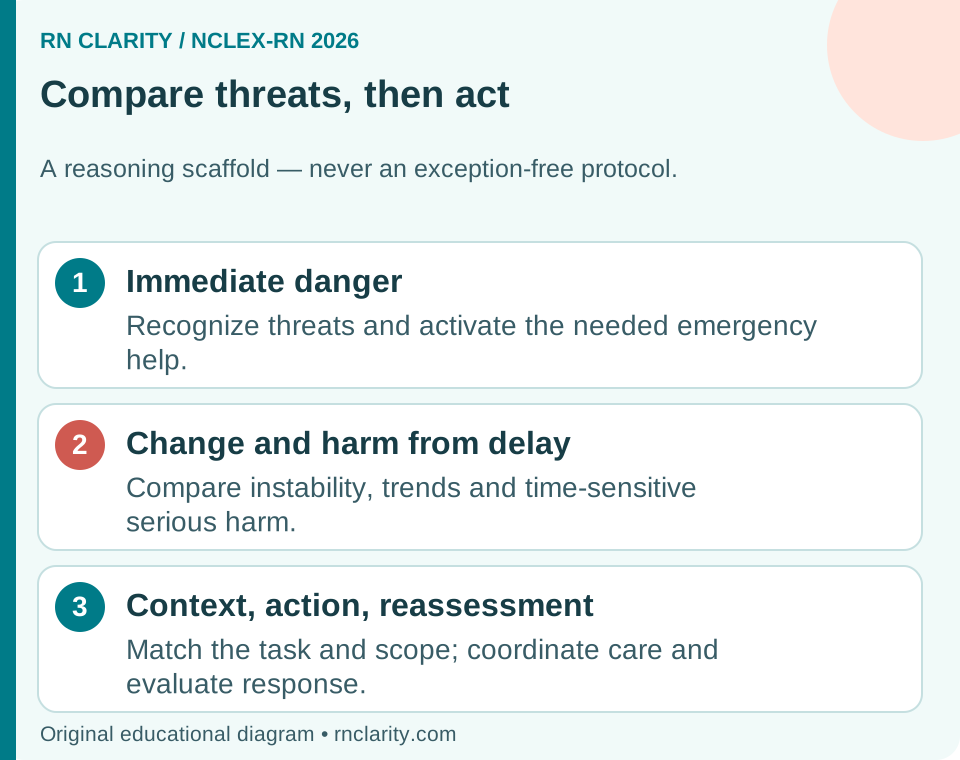
Use this sequence as a reasoning scaffold. First, identify immediate danger to the patient or others. Second, compare instability and trends. Third, compare time sensitivity and the likely consequence of delay. Fourth, use acute/chronic and expected/unexpected distinctions to refine the comparison. Fifth, choose an action or patient that matches the question and your nursing role. Sixth, plan reassessment and help for the remaining patients.
The order is not a rigid scorecard. You may need to return to an earlier step when a new cue changes the situation. For example, a patient initially described as stable may become the priority when the report adds a sudden speech change. A chronic diagnosis should not prevent you from recognizing that new emergency.
Write the comparison in one sentence: “I would see B first because the new breathing difficulty poses a more immediate threat than the stable, expected findings in A, C and D.” If you cannot explain the priority without saying “because ABC,” you may not yet have analyzed the actual cues.
The final step is often neglected. Selecting one patient does not mean abandoning the others. In practice, call for assistance, communicate urgent findings and ensure that appropriate monitoring or tasks are assigned. A multiple-choice item may require one answer, while a real shift requires coordinated care.
4. Unstable Versus Stable: Findings Before Labels
Stability is a description of the patient’s current condition and trajectory, not a permanent property of a diagnosis. A patient with a serious disease can be stable at the moment, while a patient with an apparently minor problem can suddenly deteriorate.
Look for changes in breathing effort, consciousness, perfusion, bleeding, neurologic function or other findings that suggest a threat is developing. A trend can be more important than one isolated number. A value that is worsening rapidly may need attention even if it has not reached the threshold you memorized from a study table.
Compare each option with its baseline when the stem provides one. A patient’s usual finding and a new deviation are different situations. Do not assume a baseline that was never stated, but use it when it is present. “Usually confused” and “newly confused” should not be treated as interchangeable descriptions.
Similarly, do not assume that normal-looking vital signs prove stability. A new focal neurologic deficit or a credible immediate self-harm risk can require urgent action even without a dramatic blood pressure or oxygen saturation. Physiologic numbers are valuable cues, but they are not the only cues.
For practice, underline the words that describe change: new, sudden, worsening, unable, increasing, decreased or no longer. Then ask what that change could mean and how long the patient can safely wait. This method keeps your attention on current risk rather than the name of the disease.
5. Acute Versus Chronic: A Useful Comparison With Limits
Acute problems often deserve attention because they are new and may be evolving. Chronic problems often have established management plans. That makes acute/chronic a useful comparison, but not an automatic rule that every new minor complaint outranks every longstanding illness.
A patient with chronic kidney disease who becomes newly weak and develops concerning rhythm findings is not “low priority because chronic.” The relevant issue is an acute change in a patient with a chronic condition. Conversely, a new uncomplicated minor injury with stable findings may be less urgent than a worsening chronic cardiopulmonary problem.
Separate the condition’s duration from the symptom’s duration. “Has diabetes” is chronic history. “Suddenly difficult to wake after insulin” describes a new potential emergency. A question may include both to see whether you notice that the current problem, rather than the longstanding label, determines priority.
Do not invent an emergency simply because a diagnosis can have one. The stem must support your concern. A stable patient with a chronic illness and no new findings should not be assigned a complication that the question never described. Good reasoning responds to available cues, not every possible disaster associated with the disease.
Use the distinction to ask a better question: “Is this a new or worsening threat that changes what must happen now?” That wording is more reliable than “acute always beats chronic,” and it transfers more effectively to real nursing assessment.
6. Expected Versus Unexpected: Expected Can Still Be Dangerous
An expected finding fits the patient’s condition or treatment course. An unexpected finding may signal a complication, incorrect assumption or a new problem. Unexpected changes deserve careful attention, but expected does not mean harmless.
Pain after surgery may be expected. Severe pain accompanied by concerning neurovascular changes is not safely dismissed because the patient had an operation. Some bleeding can be anticipated in particular contexts, but heavy bleeding with signs of poor perfusion is urgent even if bleeding was a known risk.
Ask three questions: Is the finding consistent with the situation? Is its degree or trend acceptable? What other cues accompany it? These questions prevent a broad label such as “normal after surgery” from obscuring a meaningful deterioration.
Unexpected findings are also not automatically the most urgent. A new mild rash in an otherwise stable patient and new severe breathing difficulty are both changes, but their time sensitivity differs. Compare the potential harm from delay rather than treating the word new as the complete answer.
When reviewing rationales, avoid explanations that stop at “this is expected.” A strong rationale explains why the described finding can reasonably wait in this specific comparison. It also identifies which new finding would change that priority. Learning the boundary is more useful than memorizing a label.
7. Airway, Breathing and Circulation—With the Arrest Exception
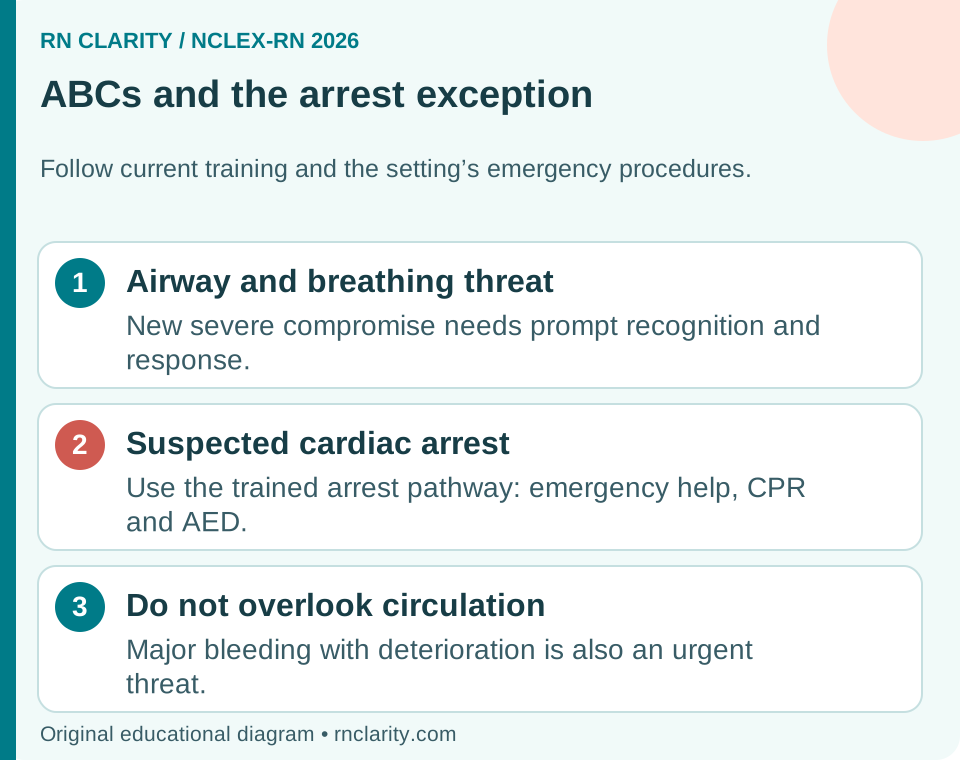
Airway, breathing and circulation help organize assessment of threats to oxygen delivery and perfusion. In many multi-patient scenarios, a threatened airway or severe respiratory compromise outranks a stable routine need. However, a mnemonic should not delay the emergency response appropriate to the situation.
For suspected adult cardiac arrest, follow the current resuscitation pathway. The 2025 American Heart Association adult basic life support guidance emphasizes recognition, emergency activation, CPR and early defibrillation. The compressions-first arrest sequence is an important exception to treating ABC as an inflexible instruction to perform a prolonged airway assessment before compressions.
The type of airway cue matters. A patient comfortably speaking in full sentences with stable findings is different from one with sudden stridor, swelling and difficulty speaking. The word respiratory in a diagnosis does not make every associated patient the first priority. Evaluate the actual evidence of compromise.
Circulation also matters when delay threatens perfusion, such as major active bleeding with deterioration. Do not let a rigid ranking cause you to overlook a clear circulatory emergency because another option contains a stable chronic breathing diagnosis.
This guide is about selecting priorities, not teaching a complete resuscitation course. Maintain current training and follow local emergency procedures. In practice, immediate help and coordinated actions may be needed at the same time; a priority framework should speed recognition and escalation, not create a serial checklist that delays them.
8. Trends, Baseline and Response to Treatment
A prioritization question may include several abnormal findings, so a trend becomes a useful tie-breaker. Ask whether the patient is improving, unchanged or worsening. A finding that persists despite an intervention may deserve more urgent attention than one that is resolving under an established plan.
Compare the intervention with its goal. If treatment was intended to improve ventilation but the patient is increasingly drowsy and breathing less effectively, the direction is concerning. “Treatment has been given” does not establish that the problem is controlled. Evaluation of the response is part of the nursing decision.
Baseline should be used carefully. If a stem states that a value is usual for that patient, consider it. If it does not, do not invent a history that makes an alarming value acceptable. Likewise, do not normalize a new change because the patient has a diagnosis that could explain it.
Look for paired cues. A blood pressure change together with new confusion or pallor may communicate more than the number alone. A laboratory result plus symptoms can indicate different urgency from the same laboratory result in an asymptomatic stable patient. The correct comparison concerns the whole presented situation.
For study, rewrite a case by changing one cue. If the patient improves, does the priority change? If the same value is new rather than baseline, does it change? This exercise teaches you the information that drives the decision rather than encouraging you to memorize a disease ranking.
9. Actual Problems, Potential Problems and Time Sensitivity
An actual serious problem usually demands attention, but “actual always beats potential” is too broad. A credible imminent threat can outrank a mild problem already present. A patient with a clear intention and means to harm themselves requires urgent safety intervention even if another patient has an actual but stable minor symptom.
Ask how likely and how serious the threatened harm is, and how quickly it could occur. A remote theoretical complication is different from an imminent risk supported by specific cues. Avoid imagining additional facts to make a low-priority option more dangerous than the stem indicates.
Time sensitivity is often the missing tie-breaker. Two patients may both need care, but one could suffer irreversible harm if you wait. That is a stronger reason for priority than the emotional drama of the complaint or the complexity of the diagnosis name.
The question may deliberately include important but deferrable needs: discharge teaching, stable pain management, routine medication administration or planned dressing care. Calling them lower priority in that moment does not mean they are unimportant. It means the first action must address a more immediate threat.
A good rationale should therefore explain both urgency and deferral. “B is first because delaying assessment could allow rapid deterioration; A, C and D still need care, but their stated findings do not show the same immediate threat.” This reasoning preserves the needs of every patient while answering the comparison.
10. Delegation and Getting Help
Prioritization includes deciding what requires your direct attention and what can be safely coordinated with another qualified team member. It does not mean that one nurse must personally perform every task in strict sequence while other patients wait unattended.
The NCSBN delegation guidance emphasizes responsibilities and jurisdiction-specific rules. Do not delegate nursing judgment or assume that a staff title authorizes the same activities in every location. Consider competence, patient circumstances, communication and supervision.
If you respond to an unstable patient, another qualified person may be able to support a stable routine need within scope. Give clear instructions, including what changes must be reported and when follow-up is required. “Help with my patients” is less useful than a specific task and reporting expectation.
Distinguish assignment from delegation when the question asks you to do so. A multi-patient item may test whether you recognize that assessment of a new deterioration requires a licensed nurse’s judgment. A request to collect routine data should not quietly become a request to independently interpret and manage instability.
In a genuine simultaneous emergency, activate the appropriate response and communicate both problems. A multiple-choice question may identify the most urgent first assessment, but clinical practice requires enough help to avoid abandoning another urgent patient. Resource coordination is a safety action, not an optional administrative extra.
11. How to Use the Original Practice Questions
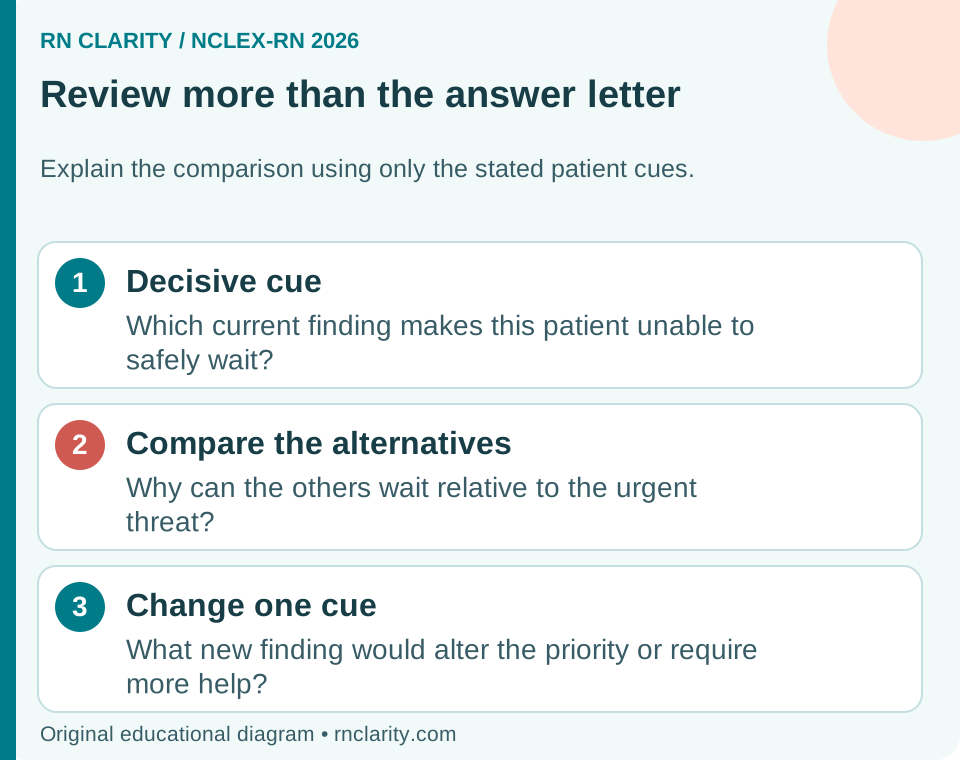
Read each case before its rationale. Choose the patient who should be assessed first based only on the stated information. Then write the decisive cue and why delay matters. Do not add a hidden symptom or assume an unstated baseline to make your preferred option correct.
For each alternative, explain why it can wait relative to the selected patient, not why it never needs care. The difference matters. A patient requesting analgesia deserves timely care even when another patient has an immediate airway threat. Prioritization is a sequence and coordination decision, not permission to ignore discomfort.
After reviewing the answer, identify one change that would alter the ranking. For example, stable chronic pain becomes a different scenario if the patient develops a sudden neurovascular deficit. This counterfactual step tests whether you understood the reasoning rather than memorized the answer letter.
The cases are simplified educational comparisons. They deliberately provide enough information to support one best first assessment among the listed options. They do not provide complete treatment protocols or replace bedside assessment. If an actual patient has alarming symptoms, use clinical escalation procedures rather than consulting a practice-question ranking.
Track errors by reasoning pattern: missed cue, invented fact, diagnosis bias, rigid mnemonic, failure to compare options or failure to recognize a trend. Those categories lead to more effective study than recording only “respiratory wrong” or “cardiac wrong.”
12. Practice Case: New Airway Threat Versus Routine Needs
At handover, which patient should the RN assess first?
- A: A patient with chronic obstructive pulmonary disease who is comfortable, speaking in full sentences and has findings unchanged from the documented baseline.
- B: A patient who has developed sudden inspiratory noise, difficulty speaking and neck swelling after a procedure.
- C: A patient with an uncomplicated ankle injury requesting help arranging discharge transport.
- D: A postoperative patient with mild incisional discomfort, stable findings and a prescribed analgesic available.
Best answer: B. The new airway-related findings indicate a potentially time-sensitive threat. The decision is driven by the current cues, not simply by the procedure name. The nurse should promptly assess and activate appropriate help rather than continue routine tasks first.
Why A is not first: The stem explicitly describes comfort and unchanged baseline findings. Do not invent an exacerbation merely because COPD can become serious. Why C is not first: Transport is a legitimate discharge need but does not have the same immediate threat. Why D is not first: Pain requires care, but the stated stable mild discomfort is lower priority in this comparison.
Tie-breaker: Both A and B relate to breathing, yet only B has new signs suggesting airway compromise. This is why “respiratory diagnosis first” is weaker than analysis of actual findings.
What would change the ranking? If A developed severe new respiratory distress, it would become urgent too and help would be needed for simultaneous care. The correct response would not be to leave either deteriorating patient unattended while finishing a rigid sequence.
13. Practice Case: Acute Change in a Chronic Disease
Which patient should the RN assess first?
- A: A patient with diabetes who is newly confused and diaphoretic after insulin, with a measured glucose of 42 mg/dL.
- B: A patient with controlled hypertension awaiting routine medication education.
- C: A patient with chronic arthritis reporting usual joint stiffness without a new change.
- D: A patient with a healing wound whose scheduled dressing supplies have arrived.
Best answer: A. A clearly low glucose together with new neurologic symptoms creates an immediate concern. Chronic diabetes does not make the acute change stable. The nurse should respond promptly under the appropriate hypoglycemia and escalation pathway, accounting for consciousness and swallowing safety.
Why B is not first: Education is important, but no urgent new problem is described. Why C is not first: The finding is explicitly usual and unchanged. Why D is not first: A scheduled task can be coordinated after the immediate threat is addressed.
Clinical boundary: Do not automatically offer oral intake to someone whose consciousness or swallowing makes it unsafe. The question asks which patient needs first assessment, not for a universal medication or dosing instruction. The NIDDK hypoglycemia explanation supports the urgency of severe low-glucose symptoms.
What would change the ranking? If the wound patient developed major bleeding and deterioration, that would create another emergency. If A had already recovered with documented reassessment and stable findings, the current priority would need to be reconsidered. History alone should not fix the ranking forever.
14. Practice Case: Expected Postoperative Pain Versus Deterioration
Which postoperative patient should the RN assess first?
- A: A patient who reports mild incisional discomfort and has unchanged stable findings.
- B: A patient whose dressing is rapidly saturating with blood and who is newly pale and lightheaded with falling blood pressure.
- C: A patient asking when a family member may visit.
- D: A patient requesting help repositioning after an uncomplicated recovery assessment.
Best answer: B. Active bleeding accompanied by deterioration presents a time-sensitive circulatory concern. Calling bleeding an expected postoperative risk does not make the observed severity and trend safe to defer.
Why A is not first: The described pain is mild and findings are stable. It still deserves care, but it does not outrank the bleeding and deterioration. Why C is not first: Information can be provided when the urgent concern is addressed. Why D is not first: Repositioning matters for comfort and prevention, but the stem gives no immediate threat.
Tie-breaker: All four patients are postoperative. That shared label cannot determine the answer. The decisive information is what is happening now: rapid bleeding, lightheadedness and worsening perfusion indicators.
What would change the ranking? New severe breathing difficulty during repositioning would make D urgent. A small stable stain without deterioration would be different from B’s current situation. The case teaches comparison of degree and trend rather than a rule that any blood on a dressing automatically wins every priority question.
15. Practice Case: Sudden Neurologic Change
Which patient should the RN assess first?
- A: A patient with a remote stroke and unchanged residual weakness, awaiting routine assistance.
- B: A patient who suddenly has new unilateral arm weakness and difficulty speaking.
- C: A patient with a longstanding tension-type headache described as unchanged, with no new neurologic findings in the report.
- D: A patient requesting a copy of discharge instructions.
Best answer: B. Sudden focal neurologic changes require rapid recognition and escalation. The nurse should identify onset or last-known-well information as part of the urgent response rather than postpone attention because the patient’s other routine observations appear acceptable.
Why A is not first: The deficits are explicitly unchanged baseline findings. Why C is not first: The stem describes an unchanged pattern without new warning cues; do not add an unreported emergency. Why D is not first: A document request does not outrank a new neurologic threat.
Source: CDC stroke signs and symptoms identifies sudden weakness and speech changes as warning signs requiring immediate action. This practice case is not a treatment eligibility decision; imaging, diagnosis and treatment selection require the appropriate clinical pathway.
What would change the ranking? A sudden major change in A would no longer be baseline. New abrupt severe headache with neurologic findings in C would also change the comparison. The useful distinction is new function loss, not whether the patient has a stroke label already attached to the chart.
16. Practice Case: Treatment Given Does Not Mean Problem Solved
Which patient should the RN assess first?
- A: A patient who has become increasingly difficult to arouse after a sedating medication and whose breathing is slow and shallow.
- B: A patient whose pain improved after treatment and who is alert with stable findings.
- C: A patient with stable chronic back discomfort asking about a follow-up appointment.
- D: A patient waiting for routine meal assistance who is alert and able to communicate needs.
Best answer: A. The new decrease in arousal and ineffective breathing pattern after medication are concerning. The nurse should assess and activate appropriate help promptly rather than assume that sleep is an acceptable treatment response.
Why B is not first: The treatment response is described as improvement without new instability. Why C is not first: The problem is stable and the request is informational. Why D is not first: Assistance should be arranged, but the stated situation does not indicate the immediate threat in A.
Tie-breaker: A and B both received treatment. Their current responses are different. The priority is not “the patient who just received medication,” but the patient whose response raises concern for deterioration.
What would change the ranking? If D could not safely swallow or suddenly showed respiratory distress, that would require reassessment. If A had an expected resting pattern, was easily aroused and had documented adequate ventilation, the comparison would be different. Do not turn this case into a rule that every sleeping patient is unstable; evaluate the actual cues.
17. Practice Case: Severe New Chest Symptoms Versus Diagnosis Bias
Which patient should the RN assess first?
- A: A patient with a history of heart failure who is comfortable with unchanged documented findings.
- B: A patient admitted for a noncardiac problem who now reports new chest pressure with diaphoresis and marked discomfort.
- C: A patient with stable chronic reflux asking about meal timing.
- D: A patient requesting routine clarification of tomorrow’s schedule.
Best answer: B. The new symptom cluster creates a time-sensitive concern that requires assessment and appropriate escalation. A noncardiac admission diagnosis should not cause the nurse to dismiss a new potentially serious problem.
Why A is not first: A serious history alone does not establish current instability. The report explicitly describes unchanged findings. Why C is not first: Stable reflux is not the same presentation as B’s new symptom cluster. Do not assume B has reflux simply because another patient does. Why D is not first: Routine information can wait relative to possible acute deterioration.
Tie-breaker: The immediate cues matter more than the chart’s main diagnosis. The nurse does not need to make a definitive diagnosis before recognizing that new chest symptoms with diaphoresis need timely assessment.
What would change the ranking? New severe respiratory distress or poor perfusion in A would make A urgent. An already evaluated and resolved symptom in B would be different from the current report. The purpose is to identify a new threat and respond, not to prescribe a specific treatment from an incomplete vignette.
18. Practice Case: Immediate Safety Risk
Which patient should the RN assess first?
- A: A patient who states a current intention to die, describes a specific plan and has immediate access to the means.
- B: A patient reporting loneliness but denying current self-harm thoughts in the stated assessment.
- C: A patient with stable mild nausea awaiting a prescribed treatment.
- D: A patient asking for information about a community support group.
Best answer: A. The credible immediate self-harm threat requires urgent safety action and appropriate help. Do not classify it as low priority merely because it is psychiatric or because vital signs may be normal. The NIMH warning-signs guide identifies expressed desire to die and making a plan as reasons to obtain help promptly.
Why B is not first: Loneliness deserves support, but the stated information does not show the same immediate threat. Why C is not first: The symptom needs care, but it is stable and mild in this comparison. Why D is not first: Resource information is useful after the immediate safety risk is addressed.
Clinical boundary: This vignette does not provide a complete suicide-risk assessment or management protocol. In practice, follow the setting’s safety and emergency procedures, obtain qualified help and do not leave an immediately unsafe patient without appropriate observation and protection.
What would change the ranking? New evidence of imminent danger in another patient would also require urgent help. Do not use the absence of a stated plan as proof that every other patient is safe in every situation. The item compares the specific facts provided and highlights that serious harm is not limited to airway or blood-pressure abnormalities.
19. Practice Case: A Laboratory Number in Context
Which patient should the RN assess first?
- A: A patient with a newly reported critical potassium result and new weakness with concerning rhythm changes reported on monitoring.
- B: A patient with a mildly abnormal laboratory result described as unchanged and already covered by the current plan.
- C: A patient awaiting routine blood collection who has no new symptoms.
- D: A patient asking when a nonurgent laboratory report will be discussed.
Best answer: A. The combination of a critical result and concerning new clinical findings is urgent. Prompt assessment, verification as appropriate and escalation should follow the local critical-result and emergency pathways. Do not delay recognition because the underlying disease is chronic.
Why B is not first: The result is described as unchanged and managed, without a new deterioration cue. Why C is not first: Routine collection does not outrank a current threat. Why D is not first: An informational request can wait relative to critical findings.
Tie-breaker: This case intentionally uses the laboratory’s critical classification rather than teaching a universal numerical threshold. Laboratories, specimen issues, clinical context and policies matter. The associated symptoms and rhythm concern make the need for first assessment clear in the presented comparison.
What would change the ranking? If A’s result were identified as a specimen problem and the patient had no concerning findings, the nurse would need to reassess the situation rather than carry forward the original assumption. If another patient developed an immediate emergency, urgent help would be needed for both. Data should be verified without ignoring the patient in front of you.
20. Practice Case: Neurovascular Change After an Injury
Which patient should the RN assess first?
- A: A patient with a recent limb injury who reports rapidly increasing pain and new numbness, with worsening distal perfusion findings in the report.
- B: A patient with a healed fracture attending routine follow-up without new symptoms.
- C: A patient with stable arthritis requesting assistance opening a meal container.
- D: A patient asking when prescribed mobility exercises should be performed.
Best answer: A. The new pain, sensory change and worsening perfusion findings raise concern for a time-sensitive neurovascular complication. The nurse should promptly assess and escalate rather than treat the symptoms as ordinary injury pain. The AAOS explanation of acute compartment syndrome supports the urgency of concerning symptoms after an injury; this vignette does not establish a definitive diagnosis.
Why B is not first: A healed injury without change does not show the same threat. Why C is not first: Assistance remains important, but the report is stable. Why D is not first: Teaching can occur after an urgent deterioration is addressed.
Tie-breaker: Pain alone does not always determine priority, and every injured limb is not automatically unstable. The cluster and trend are what make A urgent. The stem does not require a definitive diagnosis to recognize that delaying assessment could risk serious harm.
What would change the ranking? If A’s discomfort were mild, unchanged and accompanied by documented intact findings, the comparison would change. If C suddenly developed a new neurologic deficit, chronic arthritis would not explain away that change. The learning target is the ability to detect a departure from an acceptable recovery pattern.
21. Practice Case: Two Urgent Patients and Team Coordination
An RN learns that one patient has sudden severe breathing difficulty while another has major active bleeding with deteriorating perfusion. What is the most defensible approach?
- A: Finish routine documentation before deciding who is more important.
- B: Activate urgent help, communicate both emergencies and coordinate immediate responses while rapidly assessing the most immediate threat available to the nurse.
- C: Choose one patient and postpone all communication about the other until the first is completely stable.
- D: Assume the bleeding is expected and attend only to breathing.
Best answer: B. The situation contains two genuine threats. The nurse needs resources, communication and immediate care, not a mnemonic used to justify neglecting one emergency. Exact bedside sequencing depends on proximity, severity, available staff and emergency procedures, which the abbreviated vignette does not fully specify.
Why A is wrong: Routine documentation should not delay recognition and response. Why C is wrong: A serial approach without help can leave an urgent patient unattended. Why D is wrong: Major bleeding with deterioration is not safely dismissed as expected.
Tie-breaker: This case changes the task from selecting one patient in a simplified comparison to coordinating urgent care. It illustrates why a promise of an “ironclad algorithm” would be misleading. Sometimes the correct action is to obtain help rather than force every situation into a single-person queue.
What would change the approach? A lone responder, a disaster setting or specific resuscitation circumstances may require a particular emergency algorithm. Read the setting and follow the appropriate trained pathway. Do not invent resources, but do not ignore resources the stem gives you.
22. A Study Routine That Builds Transferable Prioritization
After each practice set, identify the cue that drove the priority. Record it in plain language: new loss of function, rapid worsening, treatment failure, immediate safety threat or stable expected finding. Then record the less effective reasoning you used if you missed the question.
Use contrasting pairs. Compare a chronic respiratory diagnosis with stable findings against a new airway threat. Compare routine postoperative pain against pain with worsening neurovascular signs. Compare a lab value alone against a critical result with symptoms. Contrasts teach boundaries more effectively than a list of diseases ordered from serious to less serious.
Explain every distractor. If you can only explain why the correct option is urgent, you may not have learned how to distinguish two close alternatives. Ask what would make each alternative urgent and whether that cue is actually present. This prevents invented facts from driving your answer.
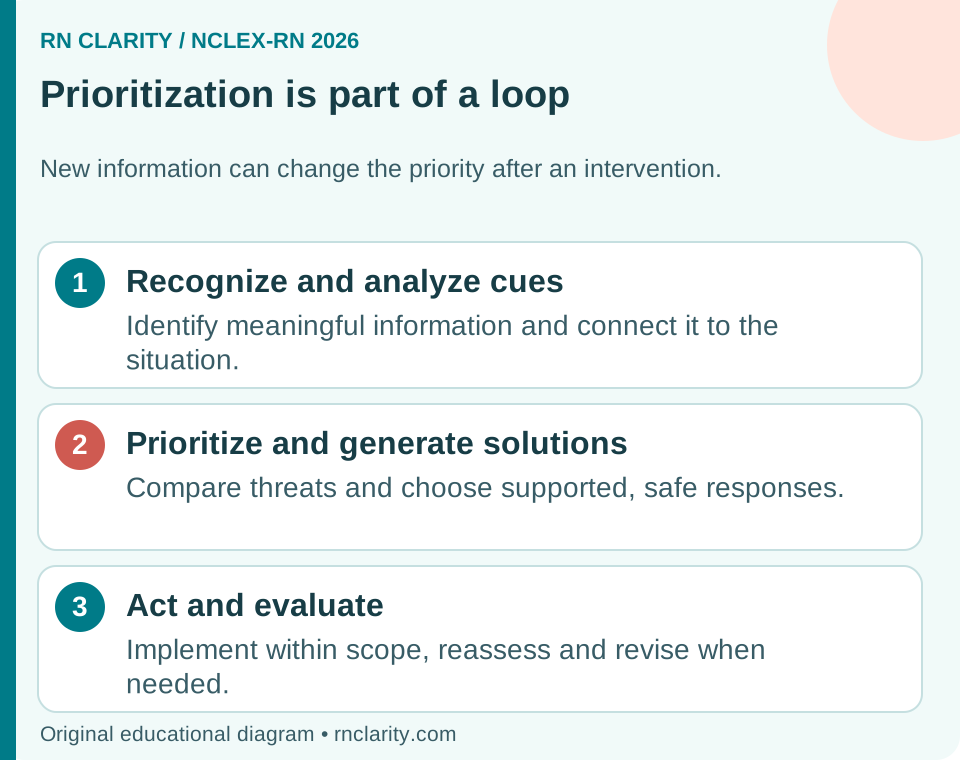
Practise the full judgment loop in longer cases. After choosing the priority, identify an appropriate action, the outcome you expect and the finding that would make you escalate or revise the plan. The NCJMM overview can help organize these steps under the 2026 examination framework.
Use scores to direct practice rather than claim certainty about licensure performance. A high practice percentage can be encouraging, but the goal is a defensible nursing decision on a fresh case. Repeatedly memorizing the same answer letters is not the same as learning prioritization.
23. Common Errors and How to Correct Them
Diagnosis bias: Choosing the patient with the most frightening disease name despite stable findings. Correction: identify the current cue and trend before considering the label. Mnemonic rigidity: Applying ABC or acute-before-chronic without analyzing exceptions. Correction: state the actual threatened function and time sensitivity.
Invented facts: Adding a possible complication that the stem does not describe. Correction: separate what is given from what is merely possible. Expected-finding dismissal: Calling a severe change normal because it can occur after treatment. Correction: assess severity, progression and associated findings.
Number fixation: Selecting the largest or smallest value without context. Correction: compare baseline, trend, symptoms and laboratory or clinical classification. Task confusion: Selecting a patient when the question asks for an action, or selecting an intervention when it asks for a finding. Correction: read the final sentence again before answering.
Ignoring reassessment: Assuming a problem is solved because medication was given. Correction: examine the response against the intended goal. Ignoring resources: Treating simultaneous emergencies as a long solo sequence. Correction: include urgent help and communication when the situation requires them.
Make the correction specific enough to practise. “Be more careful” does not tell you what to do next. “Before choosing, underline each new change and explain why delay matters” gives you a repeatable action. A useful study plan converts error patterns into habits rather than simply increasing the number of questions completed.
24. Frequently Asked Questions
Does acute always come before chronic?
No. Compare current danger and deterioration. A chronic illness can develop an acute life-threatening complication, while a new minor complaint can be stable. The decisive issue is the patient’s present condition and the consequence of delay, not the duration of the diagnosis alone.
Does unexpected always beat expected?
No. Unexpected findings deserve attention, but severity and time sensitivity matter. An expected risk can become dangerous when the actual finding is severe or worsening. A new mild finding does not automatically outrank major active deterioration in another patient.
Should I always use ABC?
Use ABC to recognize threats, while following the pathway appropriate to the emergency. Suspected cardiac arrest requires the trained resuscitation sequence, including emergency activation and prompt CPR. Do not let a rigid mnemonic delay necessary action or hide a clear circulatory or safety emergency.
Should the nurse always assess before acting?
No blanket rule fits every situation. A focused assessment may be appropriate when information is uncertain. A clearly recognized emergency requires prompt actions and help under the relevant protocol. Read what is already established in the stem and what the question actually asks.
How do I choose between two unstable patients?
Compare the immediate threat, trajectory and likely harm from delay, using the resources and setting described. In clinical practice, activate help and coordinate care for simultaneous emergencies. Do not assume that choosing one patient means the other can safely be left unattended.
Are psychiatric concerns always lower priority than physical concerns?
No. A credible immediate threat of serious harm requires urgent safety attention. Normal vital signs do not make such a threat unimportant. Evaluate the actual cues and use the appropriate safety pathway rather than classifying priority by physical versus psychiatric diagnosis.
Can I delegate an unstable patient’s assessment?
Do not delegate nursing judgment or assume that a routine data-collection task includes independent assessment and management. Follow jurisdictional scope, competence, policy and supervision requirements. Use qualified help appropriately while retaining the responsibilities attached to your role.
Are these real NCLEX questions?
No. They are original RN Clarity learning cases with rationales. They illustrate prioritization under the 2026 clinical-judgment framework without reproducing protected examination content. They are not a validated exam prediction or a complete treatment protocol.
25. References and Source Notes
Sources were checked on October 4, 2026. Clinical scenarios and diagrams are original educational illustrations. They simplify patient information to teach comparisons; bedside decisions require assessment, local policy, scope and appropriate emergency support.
- NCSBN: 2026 NCLEX-RN Test Plan — entry-level RN content framework.
- NCLEX: Clinical Judgment Measurement Model — clinical-judgment measurement framework.
- American Heart Association: 2025 Adult Basic Life Support — recognition and resuscitation context; the original RN Clarity figure is not an AHA algorithm reproduction.
- CDC: Signs and Symptoms of Stroke — sudden neurologic warning signs.
- NIDDK: Low Blood Glucose — urgency of severe hypoglycemia symptoms.
- NCSBN: Delegation — responsibilities and jurisdictional differences.
- ANA and NCSBN: Joint Statement on Delegation — nursing judgment and delegation boundaries.
For broader study, read prioritization, delegation and assignment, head-to-toe assessment and the clinical-judgment hub.