Free classroom kit · Team communication

Prioritisation & Handoff Lab

Two four-patient rounds, a changing-priority reveal and worked SBAR/check-back examples. Teach the reason behind “who first?”.

35-minute sessionFree · No loginPDF + editable HTML
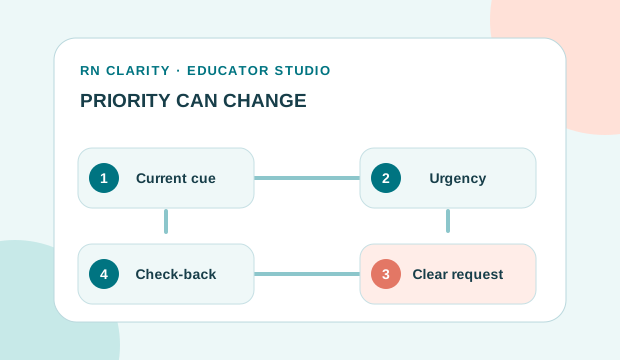
Original visual overview of Prioritisation & Handoff Lab

What learners will do

Observable learning outcomes

  • Rank patients using current cues and baseline, rather than the diagnosis label alone.
  • Re-rank when a new time-sensitive cue appears.
  • Make an explicit handoff request and verify a message using check-back.

Suggested session flow

  1. 0–5 minExplain the decision frame: immediate threat, new deterioration, baseline and time-sensitive risk.
  2. 5–15 minRank Round 1 individually, then defend the first choice with two cues.
  3. 15–25 minDiscuss Round 2 and the change-of-condition reveal.
  4. 25–35 minRehearse a handoff and a check-back, then complete the exit ticket.
Ready for learners

Learner handout

Complete the activity before opening the worked key.

Prioritisation & Handoff Lab · Learner handout

RN Clarity · Free teaching kit · 2026 NCLEX-RN alignment

A useful decision frame

Ask what is happening now, what has changed and what could cause serious harm if it waits. Airway, breathing and circulation are useful prompts, but they do not replace the actual scenario. A chronic diagnosis can have an acute crisis; an expected finding can still become dangerous when severe or worsening.

  • Identify a current threat and the time available.
  • Compare the findings with baseline and the patient’s usual treatment.
  • Separate information you have from what you must check.
  • Choose an action, name the help required and re-evaluate after new information.

Round 1 · Which assessment first?

PatientCurrent information
AA patient with chronic lung disease has a documented usual oxygen saturation of 91–92% on prescribed support. Today it is 92%, breathing is unchanged and the patient is alert.
BA patient being treated for pneumonia is newly confused, BP 88/52, respiratory rate 30/min and oxygen saturation 88% on room air. Earlier the patient was alert, BP 118/72 and saturation 96%.
CA patient one day after surgery reports incisional pain 6/10. BP, respiratory rate and alertness are unchanged; no new breathing difficulty or bleeding is reported.
DA patient ready for discharge requests help understanding the medicine list. No current change in condition is reported.

Round 1 · Learner decisions

  • Name the first patient and two cues that justify it.
  • Describe what you would do while arranging the remaining patients’ needs.
  • Explain why a diagnosis label alone cannot decide the priority.
  • What information would make you change the order? Do not invent that information as if it is already present.

Round 2 · Four more competing needs

PatientCurrent information
EAn alert patient with diabetes is trembling after a delayed meal. Capillary glucose is 54 mg/dL (3.0 mmol/L); swallowing safety has not yet been assessed.
FA patient needs a scheduled dressing change. The dressing is dry and no new concern is reported.
GA patient asks for an explanation of tomorrow’s procedure. No new symptoms are reported.
HA patient needs discharge medicine reconciliation because an OTC cold remedy and a prescription both contain acetaminophen. No recent overdose or acute symptom is reported.

Round 2 · Change-of-condition reveal

While help is being arranged, patient F becomes unresponsive and is not breathing normally.

  • How does the priority change?
  • What urgent response is required according to your training and local emergency process?
  • How would you arrange continued care for E rather than abandon a second time-sensitive need?
  • Why is a ranked list a temporary decision rather than a permanent assignment?

Build an SBAR handoff

PartYour message
Situation: what is happening now?______
Background: what context matters?______
Assessment: what findings and concern can you state?______
Recommendation/request: what do you need, and when?______

Check-back rehearsal

Use a clearly fictional, non-medication instruction: “Recheck the observations in five minutes and tell me immediately if alertness changes.” The receiver repeats the message. The sender verifies it or corrects any mismatch. A reply of “okay” alone does not establish that the message was understood.

Exit ticket

  • My first choice was based on these current cues…
  • The new cue that changed my priority was…
  • My next handoff will include an explicit request for…
For the educator

Open the facilitator key

Worked reasoning, misconceptions, feedback and adaptations.

Prioritisation & Handoff Lab · Facilitator notes & worked key

Round 1 · Key and limits

B needs urgent assessment and escalation because new confusion, hypotension and impaired oxygenation represent acute deterioration from the stated baseline. A’s chronic diagnosis does not make A first when the current data are documented as usual and stable. C still needs assessment and pain care, and D still needs a safe discharge explanation. The key does not say that these needs are unimportant.

Do not force a precise complete order for A, C and D from insufficient information. Once the immediate threat is covered, gather the missing information and coordinate appropriate care. Ask learners what might change priority: new breathing difficulty, bleeding, a fall in alertness or another actual deterioration cue.

Round 2 · Key and dynamic priority

Before the reveal, E has an immediate low-glucose problem and needs prompt assessment and the safe treatment pathway. Swallowing safety matters before offering oral treatment. H’s possible medicine duplication must be resolved before discharge, but the provided scenario does not establish an acute poisoning event. F and G have routine needs in the initial data.

After F is unresponsive and not breathing normally, activate the emergency response and begin actions consistent with current resuscitation training and local policy. Arrange another qualified team member to continue E’s time-sensitive care. This exercise is about recognising an emergency and coordinating help; it is not a resuscitation certification or a complete emergency-treatment algorithm.

A strong learner explains both the new immediate threat and the need to maintain care for the other patient. A weak answer simply changes a letter on a list without describing how the team will respond.

Worked SBAR for B

Situation: “Please assess now: my patient with pneumonia has new confusion, BP 88/52 and oxygen saturation 88% on room air.” Background: “Two hours ago the patient was alert with BP 118/72 and oxygen saturation 96%.” Assessment: “I am concerned about acute deterioration affecting breathing and circulation. The cause is not yet confirmed.” Request: “Please attend urgently; the urgent response process is being activated. Monitoring and authorised support are continuing.”

Observe whether the learner gives objective information, makes urgency clear and requests a specific response. A handoff is incomplete if it recites a history but leaves the receiver unclear about what is needed.

Worked check-back

Sender: “Recheck the observations in five minutes and tell me immediately if alertness changes.” Receiver: “I will recheck in five minutes and report any change in alertness immediately.” Sender: “Correct.”

If the receiver says “I will recheck in fifteen minutes,” the sender must correct the timing and verify the corrected message. This original teaching example uses a non-medication task to practise the communication structure without creating an invented treatment order.

Feedback that improves reasoning

Observed responseCoaching prompt
“Lung disease means airway, so A first.”“Compare A’s stated baseline with B’s new findings. Which patient is deteriorating?”
“B definitely has sepsis.”“Which findings are observed, and which cause still needs assessment?”
“F first; E can wait.”“Who will continue E’s urgent care while F receives an emergency response?”
A long handoff with no request“End with the action and urgency you need from the receiver.”

Small-group adaptation

Give each learner one patient card and have a rotating coordinator arrange care, not merely select a winner. An observer records one specific cue, one clear request and one verified message. Debrief how the order changed and what information remained missing.

Take it into your classroom

Two copies. The key stays separate.

Print/save a branded PDF, or download a self-contained editable HTML lesson file. No account or email required.

Learner handout

Activities, questions and note spaces. No worked answer keys.

Facilitator pack

Learner activities plus worked keys, feedback and references.

Open the downloaded HTML in a browser, click the lesson text to edit, then choose “Save an edited copy”. For PDF, choose your browser’s Save as PDF destination. Custom planner entries are included.