Free classroom kit · Lesson planning

Ready-to-Teach Session Planner

A realistic 30-, 45- or 60-minute teaching sequence, custom agenda builder, learner role card and assessment/exit-ticket prompts.

45-minute sessionFree · No loginPDF + editable HTML
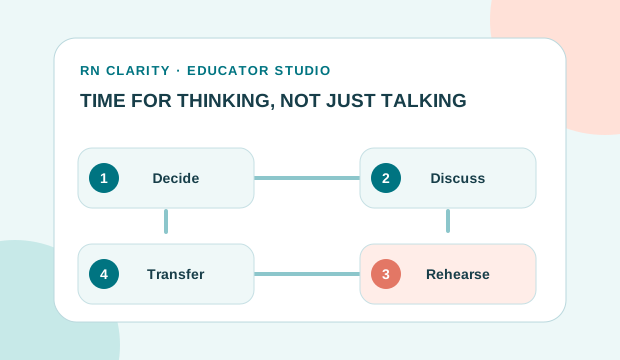
Original visual overview of Ready-to-Teach Session Planner

What learners will do

Observable learning outcomes

  • Write one observable objective tied to a decision or explanation.
  • Allocate time for independent thinking, discussion and a transfer check.
  • Choose an accessible activity and a proportionate follow-up task.

Suggested session flow

  1. 0–5 minState one objective and the boundaries of the activity.
  2. 5–10 minLet learners commit to an initial decision without revealing the key.
  3. 10–25 minDiscuss a case, request evidence and release a new cue.
  4. 25–35 minCompare with the worked key and correct one misconception.
  5. 35–45 minUse a different transfer prompt, debrief and set the next learning step.

Build a timed teaching session

Choose a kit and duration. The agenda includes time to think, discuss and check transfer. Your topic labels the session; it does not generate clinical facts.

Responding to a changing cue · 45 minutes

Kit: Clinical Judgment Case Lab. Objective: Separate observed cues from assumptions and missing information.

TimeTeaching action
0–5 minSet the objective, roles and learning boundaries.
5–10 minRecord an individual first decision before showing the key.
10–25 minUse the learner activity, compare evidence and introduce a new cue.
25–35 minUse the facilitator key to correct one misconception and rehearse the reasoning.
35–45 minTry a different transfer prompt, debrief and write an exit ticket.

Prepare: Clinical Judgment Case Lab learner handout and facilitator key. Keep the key separate until learners have committed to a response.

The agenda is included when you print or download this page’s lesson file. Entries stay in the current page; export before leaving.

Ready for learners

Learner handout

Complete the activity before opening the worked key.

Ready-to-Teach Session Planner · Learner handout

RN Clarity · Free teaching kit · 2026 NCLEX-RN alignment

Start with a decision, not a slide count

A useful objective names what learners will do and the evidence you will observe. Example: “Given an unfolding fictional case, identify the deciding cue, explain the priority and state what to reassess.” “Understand prioritisation” is harder to observe.

Choose one kit below in the planner. The generated agenda allocates the available minutes and carries the chosen objective into an editable lesson file. Your entered topic is a session label; it does not generate unverified clinical teaching content.

Learner role card

RoleTask
Cue readerReport the provided findings accurately; separate baseline from the change.
Reasoning leadState the decision and the evidence for it. Invite an alternative explanation.
ObserverRecord a specific cue, a stated uncertainty and an explicit next action.
Timekeeper / reporterKeep the discussion moving and summarise the changed reasoning.

Before the activity

  • Read the instructions and identify what is provided and what is missing.
  • Write a first decision before viewing the answer key.
  • Prepare to explain why a tempting alternative is weaker.
  • If a clinical word is unfamiliar, ask for its meaning without changing the actual term.

Transfer prompt

Use a new case or altered cue rather than repeat the same answer. Ask: “What has changed? Does the earlier action still fit? What would you reassess?” A new correct letter without explanation is not enough for this objective.

Exit ticket

  • The evidence for my decision was…
  • The alternative I rejected was… because…
  • The cue that would change my action is…
  • My next learning step is…
For the educator

Open the facilitator key

Worked reasoning, misconceptions, feedback and adaptations.

Ready-to-Teach Session Planner · Facilitator notes & worked key

Choose the right duration

LengthSuggested useWhat to leave out
30 minutesOne case or one scoring rule; short transfer check.Do not attempt all three cases plus a long lecture.
45 minutesTwo focused case decisions or a workshop with debrief.Keep background content to what the objective needs.
60 minutesA case sequence with role rotation and independent transfer.Avoid filling extra time with unrelated slides.

Worked 45-minute lesson

Topic: responding to a new deterioration cue. Objective: learners will identify the cue, explain urgency and state reassessment evidence. Preparation: learner Case 1 card and the facilitator key; check local escalation terminology.

Opening: explain that all details are fictional and the task is reasoning, not a treatment prescription. Individual work: learners write the first priority. Discussion: ask for the baseline comparison and one uncertainty. Reveal: release the improved observations with continuing reduced alertness. Feedback: compare the explanations with the key. Transfer: use a different scenario with a stable chronic condition and a new acute change. Exit: each learner writes a cue/action/reassessment statement.

Facilitator preparation checklist

  • Read the complete key before teaching. Check any local-policy adaptation and keep changes consistent across learner and faculty copies.
  • Keep the key separate until learners have committed to a response.
  • Prepare an accessible version: readable type, spoken description of visuals and time to process instructions.
  • Decide how to handle a real clinical concern raised during discussion; do not troubleshoot an identifiable patient in a public classroom document.
  • Select a follow-up task that can actually be completed in the time available.

Language and access adaptations

Keep the professional terms, then provide a short explanation and an example. Invite learners to describe reasoning in plain language before rehearsing formal communication. Allow quiet written preparation before group speaking. Provide digital and printable learner copies. Avoid relying on colour alone, animation, tiny diagram labels or one fast oral explanation.

The public kits are written in English. RN Clarity offers partial language support in selected app and lesson areas; it does not mean these entire educator packs or assessment questions are translated. Link to the language coverage page rather than promising full translation.

Evaluate the lesson, not just the learners

After teaching, record whether the objective was observable, whether learners had time to think, which misconception appeared and whether the transfer task was sufficiently different. If many learners made the same error, consider whether the instructions, explanation or activity order need improvement. Use the observation to revise the next session.

Take it into your classroom

Two copies. The key stays separate.

Print/save a branded PDF, or download a self-contained editable HTML lesson file. No account or email required.

Learner handout

Activities, questions and note spaces. No worked answer keys.

Facilitator pack

Learner activities plus worked keys, feedback and references.

Open the downloaded HTML in a browser, click the lesson text to edit, then choose “Save an edited copy”. For PDF, choose your browser’s Save as PDF destination. Custom planner entries are included.